
Listen to this Article
Sarah Tuberty moves through airports, airplanes and cities with a clarity shaped not by training manuals, but by a lifetime of lived experience that has taught her where systems support people and where they quietly fall short. Born with a congenital limb difference, disability has always been part of her life, but what it meant to her changed gradually as she grew older.
Growing up in the 1990s, she often received mixed messages about disability. Adults tried to be encouraging, while classmates responded with curiosity, discomfort or blunt questions, which made it hard to know how to make sense of it all. Strangers stared, children asked what happened and Sarah learned early how quickly attention could shift once her hand was noticed. Those moments shaped her understanding of how visible difference can alter a room, even before a word is spoken.
For much of her childhood and teenage years, she didn’t know anyone else with a limb difference, which often made her feel alone even when she was around other people. That changed when she was nineteen and volunteered at a summer camp for children with limb differences, run by occupational therapists. There, she found a sense of community and shared understanding for the first time, an experience that later led her to pursue occupational therapy as a career focused on helping people find practical, creative solutions that work for them.
Through her formal studies, Sarah was introduced to disability studies and began to recognise a pattern that would shape her work and worldview. Frustration, she learned, rarely came from her body itself. Instead, it emerged from environments, systems and expectations built around a narrow definition of normal. That understanding reframed how she thought about access, independence and support, shifting responsibility away from individuals and toward the structures surrounding them.
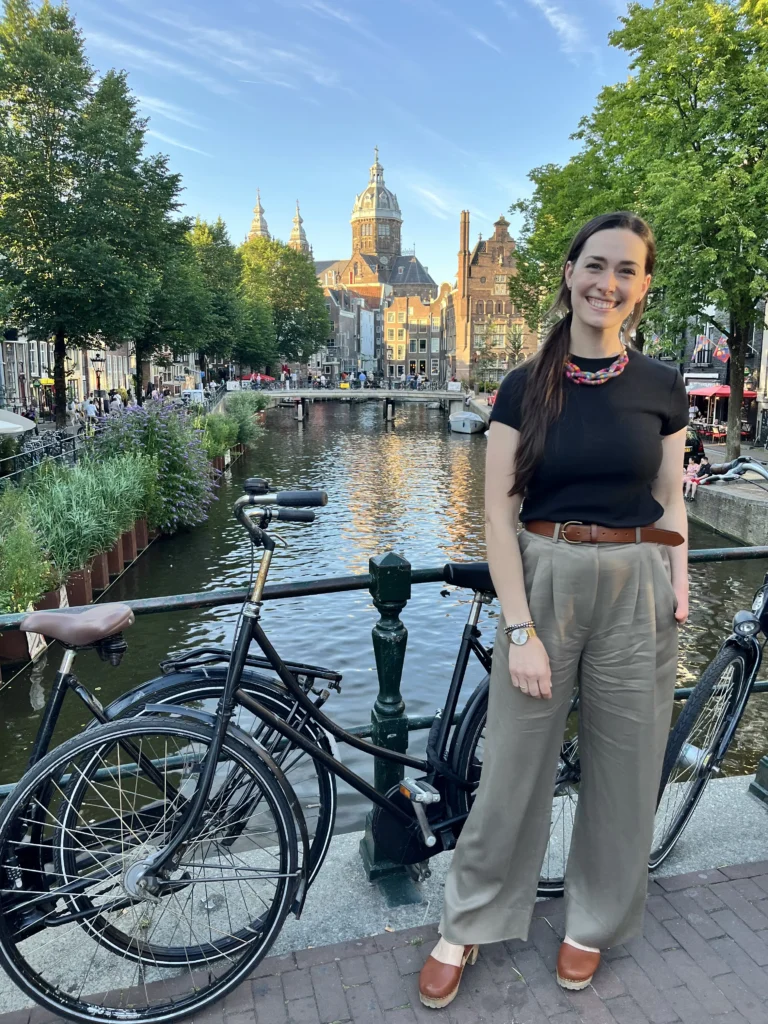
Travel had already become central to her life by then. As a high school exchange student, she spent a year living in Italy, an experience that altered her sense of belonging in ways she did not fully anticipate. In that context, she was perceived first as a foreign student rather than as a disabled person, with questions focused on where she came from instead of what happened to her hand. That shift mattered deeply. Travel offered a rare space where her body did not require explanation before connection could occur.
As an adult, travel became central to her life. She became drawn to movement, new experiences and the way travel constantly pushes her to adapt. At twenty-two, she became a flight attendant, a role that combined structure with motion and placed her in daily contact with people navigating unfamiliar environments. Early in her career, she tried to hide her hand whenever possible, moving quickly and quietly to avoid drawing attention. Shame lingered, shaped by years of internalized messaging, even as she performed her duties with competence and precision.
Over time, her training in occupational therapy began to influence how she inhabited her body at work. She stopped hiding and started using both arms openly, discovering that visibility was not only honest but efficient. Her movements became faster, her work smoother and her presence more confident. Passengers noticed. Children watched closely. Without intention or instruction, the aircraft cabin became a space of quiet education, showing that a person with a limb difference could lead safety procedures, manage complex tasks and hold authority without explanation.
The scene carries weight within an industry that continues to present significant barriers for disabled travelers. Sarah sees those barriers daily, from tight turnaround times that leave little margin for assistance, to narrow aisles that complicate transfers and overhead bins that assume reach and strength. Announcements often lack captions, assistance systems default to wheelchairs regardless of actual need and accessible bathrooms remain inadequate for many bodies.
Those challenges don’t end once passengers leave the aircraft. Her observations extend beyond aircraft interiors. Airports, she notes, overwhelm through noise, crowds and constant change, with shifting gate numbers, evolving security rules and apps that assume digital ease. What feels routine for frequent flyers can become disorienting for those who rarely travel or have added access needs. She stresses how important time, preparation and choice are, believing help should be offered, not forced, and that early boarding should feel welcoming rather than restrictive.
Outside of flying, she stays connected to movement through aerial arts such as silks and hoop. These suspended forms let her move freely and figure out what works for her body, rather than forcing it to fit a standard approach. Some moves aren’t an option, but others come naturally, with her elbow offering strength and stability in place of a hand. In the air, the equipment becomes a partner, supporting movement instead of measuring limits.
That philosophy carried into an accessible performance she co-created in Philadelphia as part of the Fringe Arts Festival, where audiences were invited to sit, stand or lie on mats, and where lighting, pacing and storytelling prioritized access rather than spectacle. One performance addressed the persistent question directed at her body, culminating in a fabricated hand filled with confetti that tore open mid-act shifting the focus away from her body and toward her own control and expression.
That experience reflects a broader pattern she continues to observe while traveling. It continues to reinforce her understanding of culture and access, revealing how infrastructure, social attitudes and informal kindness intersect in different places. Some destinations offer strong disability pride, while others rely on older layouts that complicate navigation. Curiosity can feel respectful or invasive depending on context, and she has learned to navigate both while remaining open to connection.
When asked for practical guidance, Sarah focuses on small decisions with outsized impact, recommending four-wheel suitcases to reduce strain, backpacks that slide over luggage handles to free hands and solid toiletries that eliminate spills. She advises building itineraries with fewer connections, allowing extra time and starting with shorter trips to build confidence.
What comes through from her experience isn’t a set of rules or arguments, but what she’s learned from living it. Travel quickly shows how places are designed and who they’re designed for, and simply being visible can slowly change how people think and what they expect. Sarah Tuberty lives and travels openly, helping to normalize disability through the way she works, moves and shows up each day.