
by Matthew “Matty” Medeiros
Listen to this Article
I still remember the first time I approached airport security with my mobility scooter. Before that moment, travelling had always been easy. I used to glide through checkpoints without a second thought, never stopping to consider how much my body made the process simple. But after my arthritis diagnosis and the progression that eventually required me to use a scooter for long distances, everything suddenly felt different. I worried about whether my scooter, cane, and charger would cause issues. I worried about slowing down the line. I worried about being watched. Mostly, I worried about navigating a world I no longer fit the way I once did.
But something shifted that day. Despite my anxiety, I pushed forward, asked for what I needed, and listened carefully as officers explained each step. I realized that I could do this, and that self-advocacy was not only allowed but necessary. Each time I travelled afterwards, it became easier. Now I have gone through more security checkpoints than I can count, and instead of fear, I carry confidence. I want this article to offer that same confidence to anyone travelling with mobility aids, prosthetics, hidden disabilities, or identities that security systems are not always prepared for.
The Reality: Security Is Not Always Built with Us in Mind
Airport security can be intimidating even on a good day, and it becomes even more challenging when your body, identity, or assistive devices do not fit the system’s expectations. Many travellers with disabilities, as well as queer and transgender travellers, find themselves navigating structures that were not designed with them in mind. It is important to acknowledge that there are many compassionate security officers who act with patience and kindness, and some airports are improving their training. But rushed environments, inconsistent procedures, and a lack of awareness can still create moments that feel stressful or unsafe.
Awareness from travel professionals, airport staff, and airlines makes a real difference. Inclusion does not start at the destination. It starts at the checkpoint.
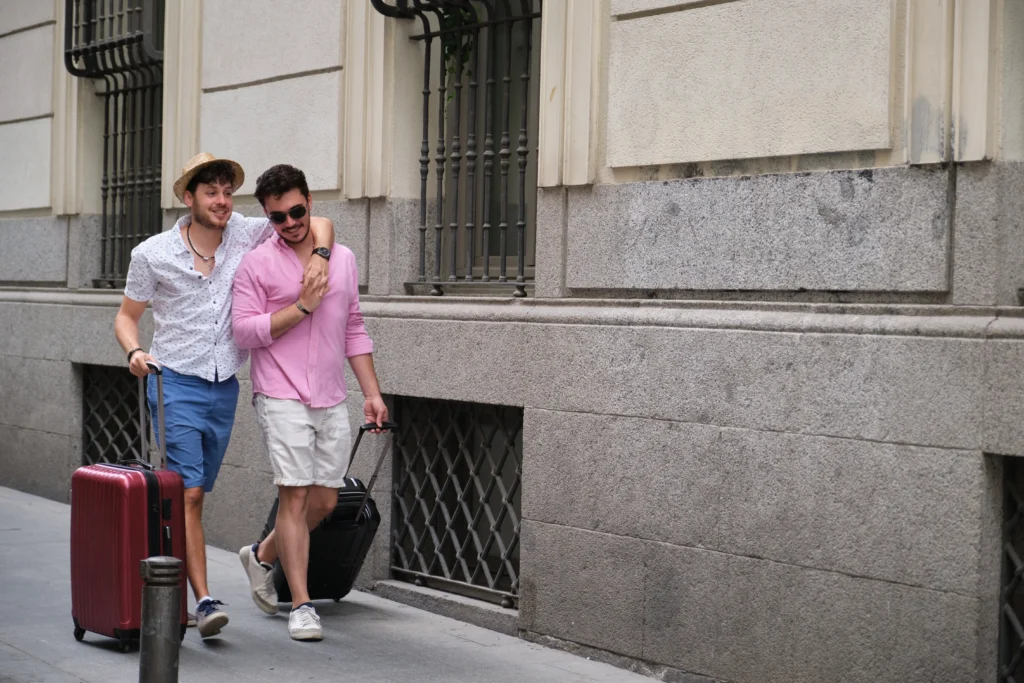
For travellers who use mobility aids, prosthetics, assistive devices, or who live with invisible disabilities, visibility can be complicated. For queer and transgender travellers, the experience can be just as layered. Security is an environment where identity becomes intensely visible and sometimes uncomfortably scrutinized.
Even with these challenges, visibility remains powerful. Seeing travellers like us represented in airports, marketing materials, or accessibility programs tells us we belong. We are not exceptions to the travel experience. We are part of it. When the system recognizes our needs and identities, it becomes easier to move through it with dignity.
“Airports are crossroads of the world; they should also be crossroads of belonging.”
Mobility Aids: What You Should Expect
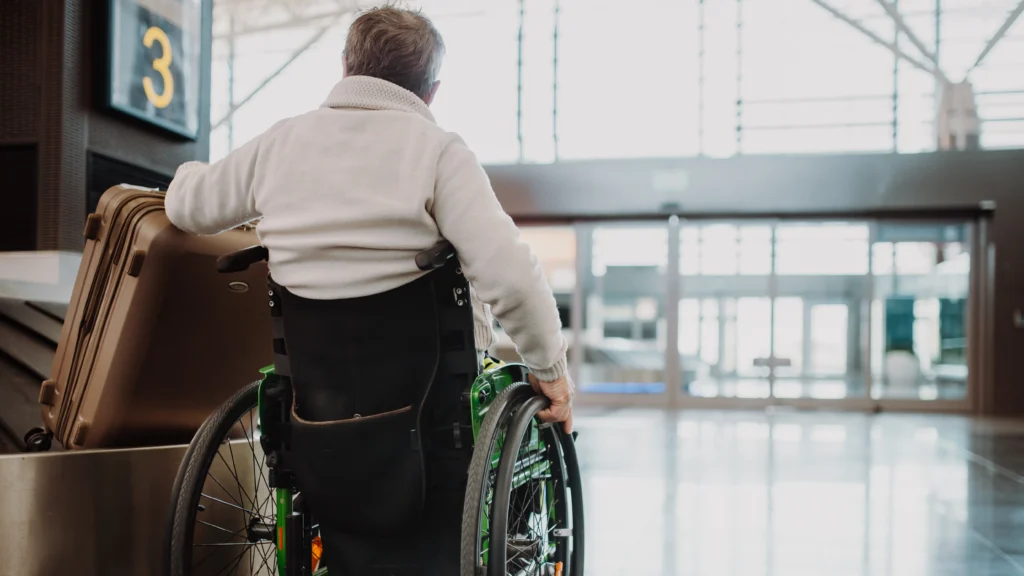
In most countries, travellers can remain with their mobility devices, including scooters, power chairs, and walkers, throughout most of the screening process. Officers may conduct a visual inspection, swab the device for explosive trace detection, and perform a manual pat-down if body scanners are not accessible or appropriate.
Battery rules can be confusing, but guidance is consistent around the world. Lithium-ion batteries for mobility devices are allowed. Depending on their watt-hour rating, batteries may remain installed or be carried separately in the cabin. Always check with your airline as well as international regulations before flying. Helpful resources include CATSA’s mobility aid guidance the Federal Aviation Administration’s page on travelling with wheelchairs and mobility devices at and IATA battery regulations.
One thing I always remind myself, and others, is that taking extra time is completely allowed. Travellers using mobility aids are not expected to rush. Your safety, comfort, and dignity matter more than keeping pace with the line.
Prosthetics and Assistive Devices
Travellers who use prosthetics or limb supports may trigger alarms in body scanners. This is completely normal. You are not required to remove your prosthetic for screening. Officers may conduct a pat down or use explosive trace detection, but they should explain every step clearly. Some travellers choose to carry a letter from a doctor or prosthetist, not because it is required, but because it brings peace of mind. Your body is not the issue. The system simply needs to continue evolving.
Neurodivergent and Hidden Disabilities
Airports can be overwhelming for anyone, but for travellers with ADHD, autism, sensory processing differences, PTSD, or anxiety, the environment can feel especially intense. Bright lights, large crowds, unpredictable noises, and sudden instructions can trigger overload or distress.
One program that has made a meaningful difference is the Hidden Disabilities Sunflower Program. This global initiative helps travellers discreetly signal that they may need extra support, additional time, or clearer communication. Wearing a sunflower lanyard, pin, or badge communicates that you have a hidden disability without requiring disclosure. Security officers trained in the program respond with patience, awareness, and flexibility. The Sunflower is recognized in Canada, the United States, the United Kingdom, the European Union, Australia, and many major attractions, cruise lines, and transportation providers. Travellers can learn more or order a lanyard here.
A disability does not need to be visible to be valid. The Sunflower Program helps respectfully bridge that understanding.
Transgender and Gender Diverse Travellers
For transgender and gender diverse travellers, airport security can be especially challenging. Body scanners often rely on gendered settings that do not reflect real bodies, and pat-down procedures may be assigned based on assumptions. This can create uncomfortable or unsafe moments.
Travellers should know they have options, including the choice to request a private screening and to ask for an officer of the gender they prefer. You are never required to justify your gender or explain your body, and you have the right to be treated with dignity throughout the process.
For additional guidance, the National Center for Transgender Equality offers a clear and supportive guide that outlines what to expect at airport security and how to self-advocate with confidence.
No one should ever have to choose between safety and dignity. Airports and agencies must continue improving their training and procedures so that every traveller feels seen, respected, and welcome.
Finding Confidence: Tips for a Smoother Journey
Preparation can make a meaningful difference. Calling airport accessibility programs or services like CATSA Passenger Support or TSA Cares before your trip can help you understand what to expect. Clear communication at the beginning of the screening process often leads to a smoother experience. Bringing documentation for medical devices or prosthetics is optional, but it can provide comfort. Neurodivergent travellers may find it helpful to prepare scripts or bring sensory tools. Transgender travellers can request private screenings or specify the gender of the officer conducting them. Mobility aid users should keep chargers accessible and be ready to explain how their device operates.
Confidence creates momentum, and you deserve to take up space in every part of your journey.
To every traveller who has ever felt watched, questioned, or underestimated, I want you to hear this clearly. You belong in every gate, lounge, terminal, and destination. Your body belongs. Your identity belongs. Your truth belongs. And the more we show up, the more the world learns to make room for all of us.
If we were sitting together right now, sharing a quiet moment before your flight, I would remind you that you have already come this far, and that is something to be proud of. Whatever challenges appear, you will navigate them with the strength you have built over time. You will ask questions, advocate for yourself, and take the time you deserve. And when you finally settle into your seat, maybe a little tired but triumphant, I hope you recognize what you eventually did. That despite every barrier placed in your way, you travelled anyway.
And that makes you POWERFUL!
Let’s Stay Connected
