
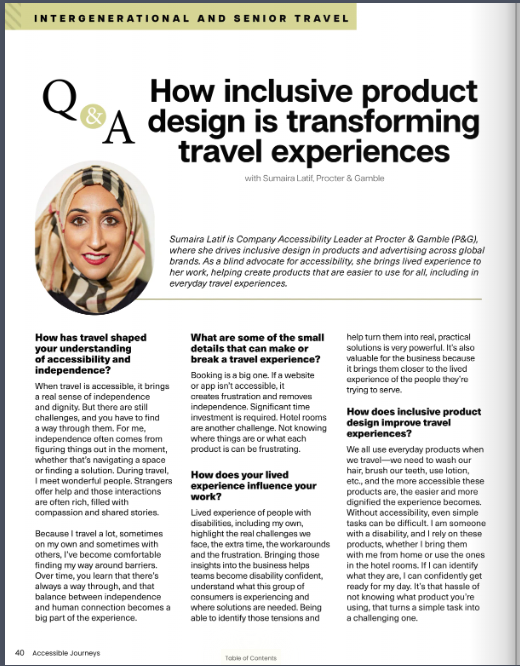
with Sumaira Latif, Procter & Gamble
Sumaira Latif is Company Accessibility Leader at Procter & Gamble (P&G), where she drives inclusive design in products and advertising across global brands. As a blind advocate for accessibility, she brings lived experience to her work, helping create products that are easier to use for all, including in everyday travel experiences.
Listen to this Article
Q: How has travel shaped your understanding of accessibility and independence?
A: When travel is accessible, it brings a real sense of independence and dignity. But there are still challenges, and you have to find a way through them. For me, independence often comes from figuring things out in the moment, whether that’s navigating a space or finding a solution. During travel, I meet wonderful people. Strangers offer help and those interactions are often rich, filled with compassion and shared stories.
Because I travel a lot, sometimes on my own and sometimes with others, I’ve become comfortable finding my way around barriers. Over time, you learn that there’s always a way through, and that balance between independence and human connection becomes a big part of the experience.
Q: What are some of the small details that can make or break a travel experience?
A: Booking is a big one. If a website or app isn’t accessible, it creates frustration and removes independence. Significant time investment is required. Hotel rooms are another challenge. Not knowing where things are or what each product is can be frustrating.
Q: How does your lived experience influence your work?
A: Lived experience of people with disabilities, including my own, highlight the real challenges we face, the extra time, the workarounds and the frustration. Bringing those insights into the business helps teams become disability confident, understand what this group of consumers is experiencing and where solutions are needed. Being able to identify those tensions and help turn them into real, practical solutions is very powerful. It’s also valuable for the business because it brings them closer to the lived experience of the people they’re trying to serve.
Q: How does inclusive product design improve travel experiences?
A: We all use everyday products when we travel—we need to wash our hair, brush our teeth, use lotion, etc., and the more accessible these products are, the easier and more dignified the experience becomes. Without accessibility, even simple tasks can be difficult. I am someone with a disability, and I rely on these products, whether I bring them with me from home or use the ones in the hotel rooms. If I can identify what they are, I can confidently get ready for my day. It’s that hassle of not knowing what product you’re using, that turns a simple task into a challenging one. On the flip side, when products are accessible, you don’t even think about it. It just feels easy and simple, like it should.
That same ease becomes even more important when you’re travelling in unfamiliar environments. When travelling abroad, language can sometimes be a barrier. Tools like NaviLens code allow you to find products and get information in your own language. It’s also important that products are easy to open and easy to use. That’s why accessible products are so important in everyday life, including travel.
Q: Building on that, in what ways do tactile symbol systems help travellers confidently identify and use products on the go?
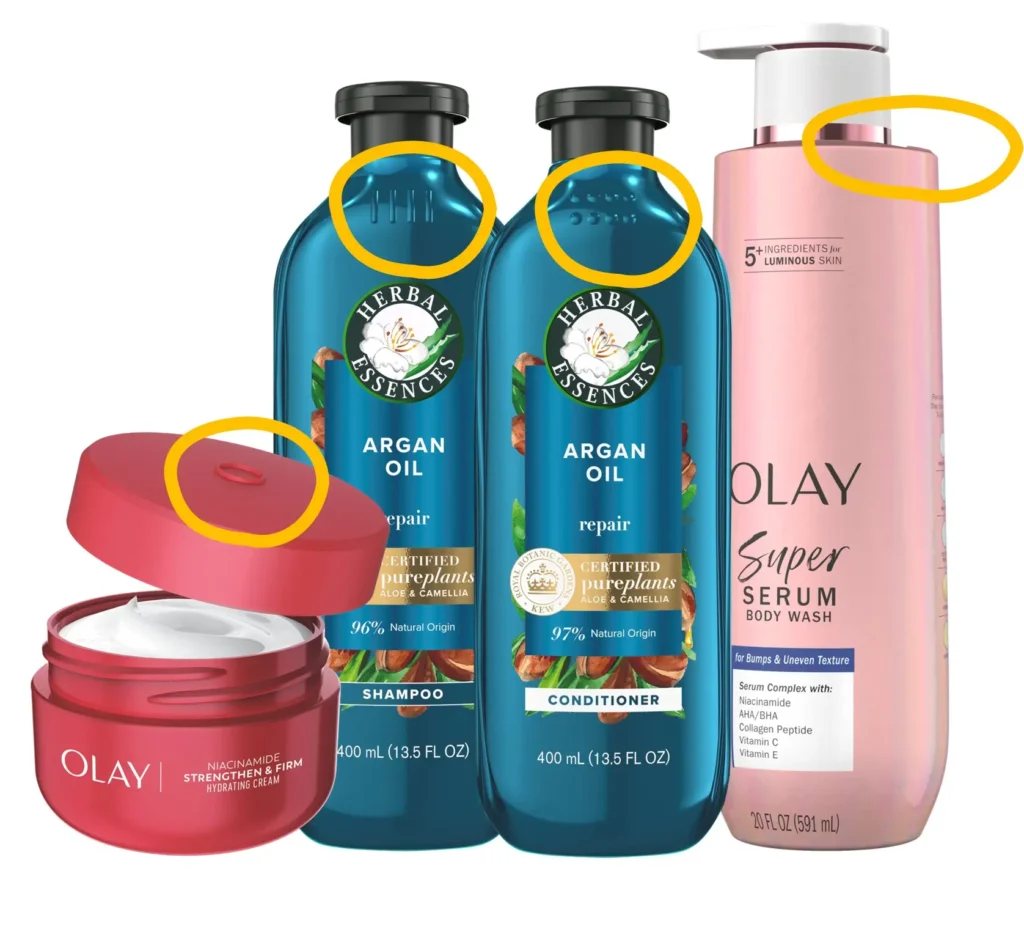
A: At P&G, we’re building tactile symbols directly into our products. In the U.S. and Canada, for example, Herbal Essences shampoos and conditioners feature these symbols on the bottles. They’ve also been introduced on Olay body wash and selected Olay face creams. It’s a simple system designed not only for blind users, but for anyone who may struggle to read labels, whether that’s without glasses in the shower, not understanding the language or due to small print. Through touch, it allows people to confidently identify whether a product is shampoo, conditioner or face cream.
- One stripe: body wash
- Two stripes: hand wash
- Four stripes: shampoo
- Eight dots: conditioner
- One circle: face cream
Q: While travelling, what challenges have you faced when products or information are not accessible?
A: Hotel bathrooms are a common challenge, not knowing what’s in the bottles. That happens all the time and can be frustrating.
Another example is when you need something from a pharmacy. If you’re in a country where you don’t speak the language, it can be difficult to know what you’re buying. I remember having a rash on my face while I was in Germany and needing an antihistamine. Neither I nor the person with me could identify which product was the antihistamine. That kind of situation is a real risk. Not being able to access or understand information on packaging, especially in another language, can be not only frustrating but potentially dangerous when you don’t know what you’re using. This is where tools like NaviLens or tactile symbols could make a meaningful difference.
Q: What P&G product do you think stand out the most for travellers?
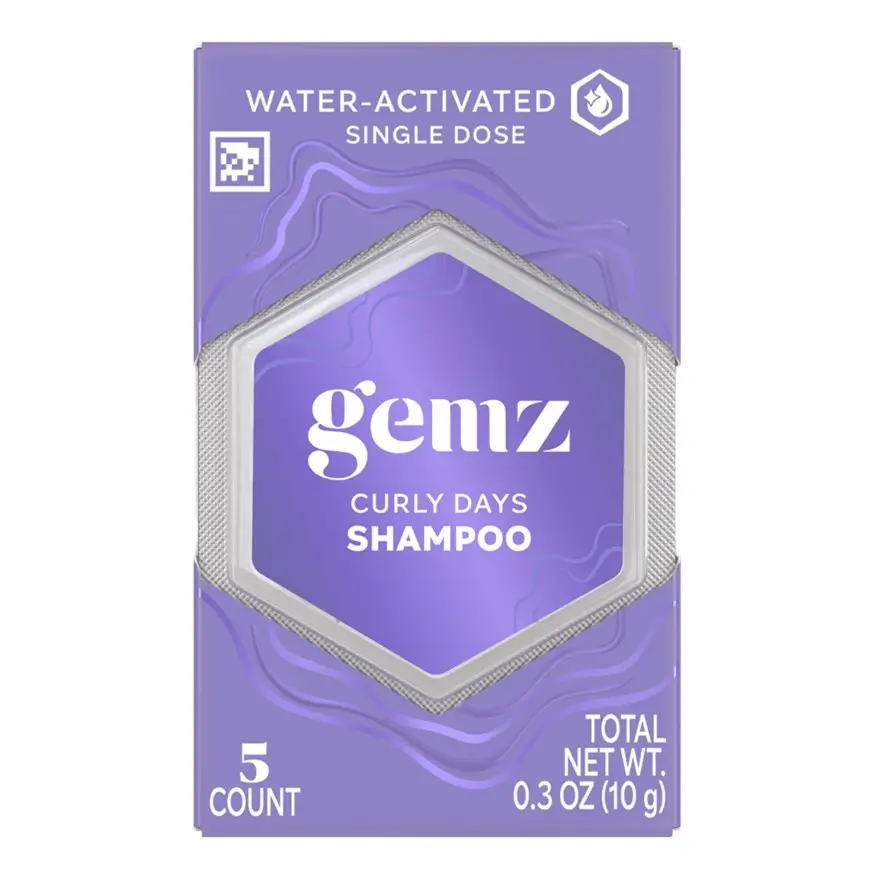
A: Tactile symbols on shampoo and conditioner are a big one. We’ve had feedback from people saying they can easily identify these products, which makes a real difference. Also, Gemz, for instance, are a great, accessible, travel friendly shampoo and conditioner that’s available in Target and shopGemz.com. They feature lightweight, single-dose, water-free tiles that also include NaviLens.
Another example is the Oral-B Disney Magic Timer App (Android / iOS). It has helped neurodivergent children who previously refused to brush their teeth twice a day, something that becomes even more important when routines are disrupted during travel.
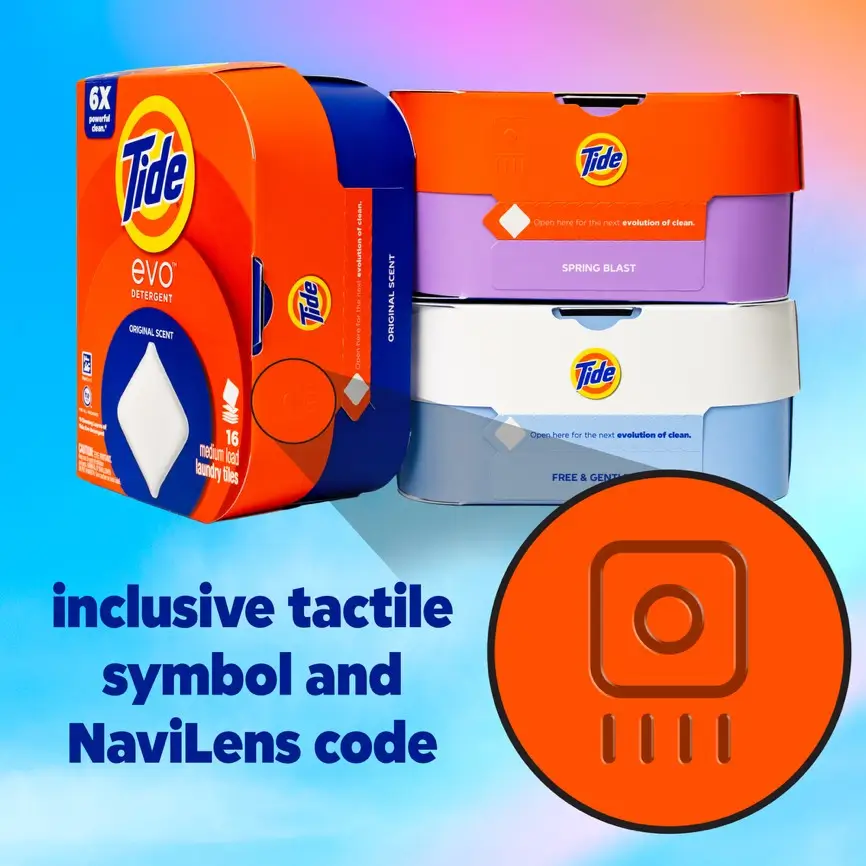
There’s also Tide evo, recently launched in the U.S. It’s a liquid-free laundry detergent that’s lightweight, easy to travel with and safe for TSA. The packaging includes our laundry detergent tactile symbol, NaviLens and simple pictograms to guide use. It packs easily and makes doing laundry in an Airbnb or wherever you’re staying simple and hassle-free.
Q: What do you hope travellers notice about P&G’s inclusive product design?
A: I’d love for people to notice the stripes and dots on shampoo and conditioner bottles. These two products are used by everyone at home and when they travel, so it’s an easy way to experience how a small design change can make a difference.
Q: Have you encountered a situation while travelling that directly influenced your thinking around inclusive design?
A: I was in Spain and tried NaviLens on their public transport. They have it, not just on products but, on bus stops and train stations as well. Using my phone, I was able to navigate the metro independently, go down the stairs, through the gates and along the platform. There was also a tactile line on the floor. NaviLens guided me step by step, telling me to go forward, turn left and where the train doors would open. It helped me get all the way to the train that took me to the airport all on my own. It was really cool. This showed me what’s possible when accessibility is built in, that I can navigate independently without relying on others at every step.
NaviLens is on transport networks across the world, like on the New York subway, Singapore SMRT and Melbourne’s Yarra Trams as well.
Q: How do inclusively designed products support families travelling together across generations?
A: As we age, things can become harder to open, read and use, so inclusive design helps make everyday tasks easier for everyone. That becomes especially important when travelling with different generations, where different needs come together. On a multi-generational trip, for example, families may be using products for children, like Pampers (in the UK it includes NaviLens codes), Oral-B toothbrushes that help kids engage with brushing, alongside products like Always Discreet for older adults, as well as everyday essentials like shampoo and conditioner. When these products are easier to identify and use, it reduces stress and guesswork, making the overall experience smoother and more manageable for everyone travelling together.
Q: What responsibility do global brands like P&G have in shaping more inclusive travel experiences, even though they are not traditionally seen as part of the travel industry?
A: It’s both a responsibility and an opportunity. The more accessible and inclusively designed a product is, the more people can use it with ease, including when they’re travelling. Inclusive design shouldn’t be treated as an add-on. It should be built in from the start so as many people as possible can access and use the product, wherever they are. When that happens, it naturally builds loyalty. Consumers today switch brands quickly, so making products easier to use is a real driver of growth.
In a travel context, that ease becomes even more important, because people are often in unfamiliar environments and out of their routines. If something is designed well, like Tide evo, it simply becomes the superior option. If I can use it with one hand, it’s more convenient than alternatives. That’s where inclusive design makes a difference, it works better for more people.
Q: How can travellers advocate for accessibility?
A: It’s very powerful to give feedback to manufacturers or service providers. I consistently let hotels know when their products or services are not accessible. If we don’t voice it, nothing changes. People become very loyal to brands that care about accessibility because they make the experience more enjoyable.
Q: Any practical tips for travellers?
A: From my own experience, it’s helpful to travel with a few elastic bands. You can wrap them around items to easily tell them apart. And, embrace help when you need it. Take the time to get to know the person helping you. They have a story too, and those moments can make the experience more meaningful.