
By Alicia Williams
Listen to this Article
Historic cities, with their centuries-old streets, buildings and public spaces, are often loved for their character, but those same features can also create significant accessibility barriers. Many have cobblestone streets worn smooth over centuries, stone staircases leading into churches and museums, and narrow lanes designed long before wheelchairs, mobility scooters or even cars existed. Bridges can rise steeply over canals, doorways may be too narrow and pavements can disappear without warning.
It is easy, then, to accept the familiar explanation: the city is old and nothing can be done. But is that really true? Admittedly, historic cities present genuine accessibility challenges and preservation matter but preservation and accessibility are not necessarily opposing forces.
Historic England, which provides guidance on protecting England’s heritage while improving access, encourages owners and designers to find creative solutions that preserve a building’s significance. These can include altering routes, rehanging doors or introducing carefully designed ramps and lifts. The message is clear: age and heritage value do not automatically make a place untouchable.
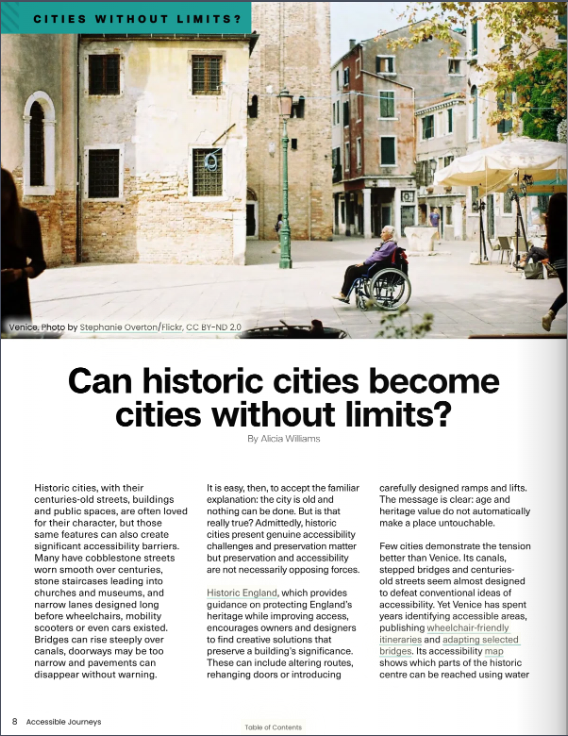
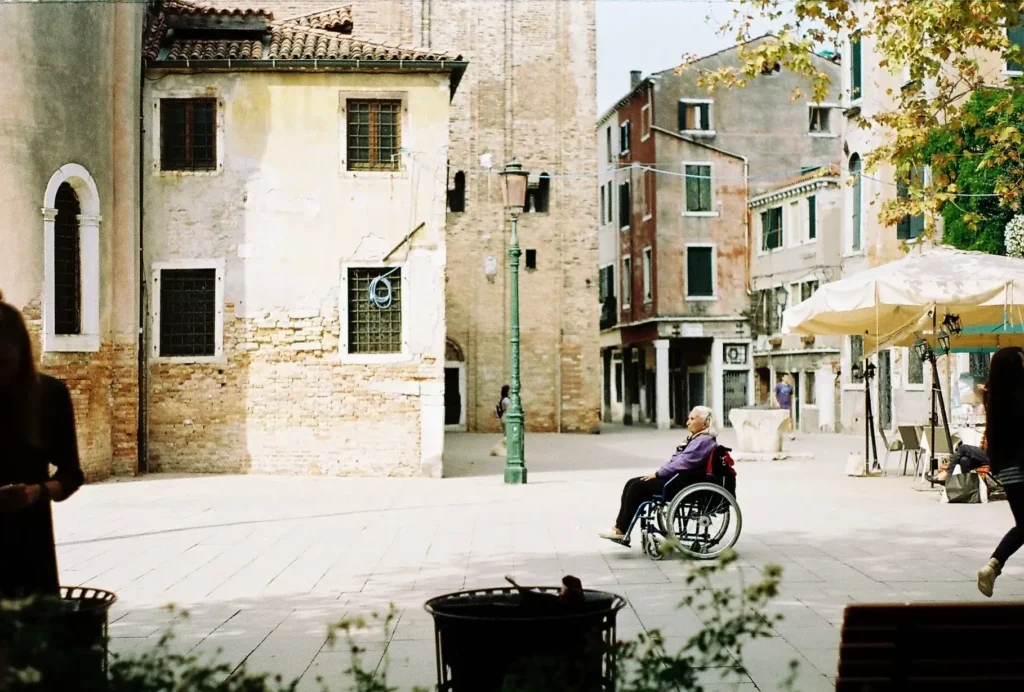
Few cities demonstrate the tension better than Venice. Its canals, stepped bridges and centuries-old streets seem almost designed to defeat conventional ideas of accessibility. Yet Venice has spent years identifying accessible areas, publishing wheelchair-friendly itineraries and adapting selected bridges. Its accessibility map shows which parts of the historic centre can be reached using water transport and which bridges have lifts, platforms or modified steps.
And the work continues. In September 2026, Venice began work to install new removable metal ramps on several bridges as part of a broader programme to remove architectural barriers from pedestrian routes through the historic centre. Venice has not become perfectly accessible, but perhaps that is precisely the point. Accessibility does not depend on solving every barrier at once. It begins with recognizing that a barrier can, and should, be addressed.

Ávila, Spain, offers another lesson. Surrounded by extraordinary medieval walls, the city could easily have concluded that its heritage made meaningful accessibility unrealistic. Instead, it invested in removing barriers across public spaces, buildings and transport, while also developing accessible tourism and cognitive accessibility. Those efforts helped Ávila become the first recipient of the European Access City Award in 2011.
Physical alterations, however, are only part of the answer. A blind traveller may need tactile interpretation, audio description or a model that allows architecture to be understood through touch. A Deaf visitor may need captioning or sign-language interpretation. A neurodivergent traveller may benefit from clear information about crowds, noise, lighting and what to expect before arriving. In 2026, UNESCO explored this broader idea in Yogyakarta, Indonesia, working with people with visual impairments and heritage professionals to test ways of experiencing heritage beyond traditional, predominantly visual interpretation.

This broadens the idea of accessibility from simply being able to enter a historic place to being able to understand, experience and engage with it. Perhaps a fifteenth-century tower cannot accommodate an elevator, or one ancient alley genuinely cannot be made wheelchair accessible. But accessibility is rarely an all-or-nothing proposition. Where one barrier cannot be removed, there may still be other ways to improve the experience through alternative routes, better information, interpretation, assistance or access to nearby spaces.
Historic cities exist because generations chose to preserve them. The challenge now is deciding who those cities are being preserved for. A historic city may never become a city without a single physical barrier but it can become a place where barriers are questioned rather than accepted. It can also be one where conservation specialists and disabled people design solutions together, and where “it has always been this way” is no longer considered an answer.
Perhaps that is what a city without limits really means.