
By Jennifer Allen and Tiffany Lund

Listen to this Article
Sustainable: able to be maintained or continued over a long time without exhausting natural resources or causing severe damage to the environment. Cambridge Dictionary.
Truthfully, sustainability is a beautiful thing that I’ve always wanted to support, but when it comes down to booking it’s rarely practical with accessibility needs. I don’t filter my travel searches by sustainability: I filter for our accessibility needs.
I stumbled upon Havarti Haus in New Hampshire through an Instagram post and added it to my bucket list primarily because it’s stunning, and the kind of place one has on a bucket list. Add to that the surprising accessibility features, all designed with sustainability in mind, and we discovered a new kind of stay.
Tiffany and Jim designed this luxury cabin to meet the accessibility needs of their son. I’m beginning to learn that some of the best places to stay were made by people like us who couldn’t find a vacation that worked for them. The story of how Havarti Haus came to be is theirs to tell.
Behind the scenes of Havarti Haus with its builders
When we set out to build Havarti Haus, a wheelchair accessible mountain retreat in New Hampshire, sustainability was important to us, but it wasn’t our primary goal. We wanted to create a place that was first and foremost accessible, but also safe, durable, beautiful, sustainable, and within budget.
Although we had previously renovated our 1890s home to make it wheelchair accessible, we had zero experience building a house from the ground up! We quickly discovered that many sustainable choices also created a more comfortable and resilient home. There are a million decisions to make when building a home, and to me, designing Havarti Haus was about finding the balance between many priorities and making thoughtful choices.
Our sustainability journey started with the land itself. We preserved as much of the natural landscape as possible, kept existing tree buffers, and chose native plantings, clover, and wildflowers that require less water and maintenance. We also carefully oriented the house to take advantage of the southern sun. Large triple-pane windows bring in natural light and winter warmth, while a cantilever overhang helps shade the home during the summer. These simple design decisions reduce energy use while helping guests feel connected to the surrounding mountains.
The next step was building a high-performance shell. We used panelized construction to reduce material waste and invested in a well-insulated, airtight building envelope with high-performance windows and exterior insulation. Rather than relying on oversized gas-driven mechanical systems, we focused on creating a home that naturally holds heat in winter and stays comfortable in summer. And because the envelope performs so well, we were able to use efficient systems throughout the house. Havarti Haus is electricity powered wherever possible, including a cold-climate heat pump, induction cooking, and an energy recovery ventilation system that continuously supplies fresh air. Despite skepticism that a heat pump could handle New Hampshire winters, it has kept the house (and our guests) comfortable through two winters of sub-zero temperatures without backup furnace heat.
Inside, we focused on durability and longevity. We invested in quality furnishings, incorporated many secondhand pieces, and selected low-maintenance materials that can withstand years of use from guests. Ultimately, our approach to sustainability isn’t about being perfect, but rather about making thoughtful choices that will stand the test of time. In many ways, accessibility and sustainability share the same goal: creating places that can be enjoyed by more people, for more years, with less impact along the way.
A new take on sustainability
Reflecting on our stay, I’m drawn to a different type of sustainability. I can’t help but think about how a place like this makes travel sustainable for us. A typical vacation involves extensive planning, finagling, and then physical labor to make things work.
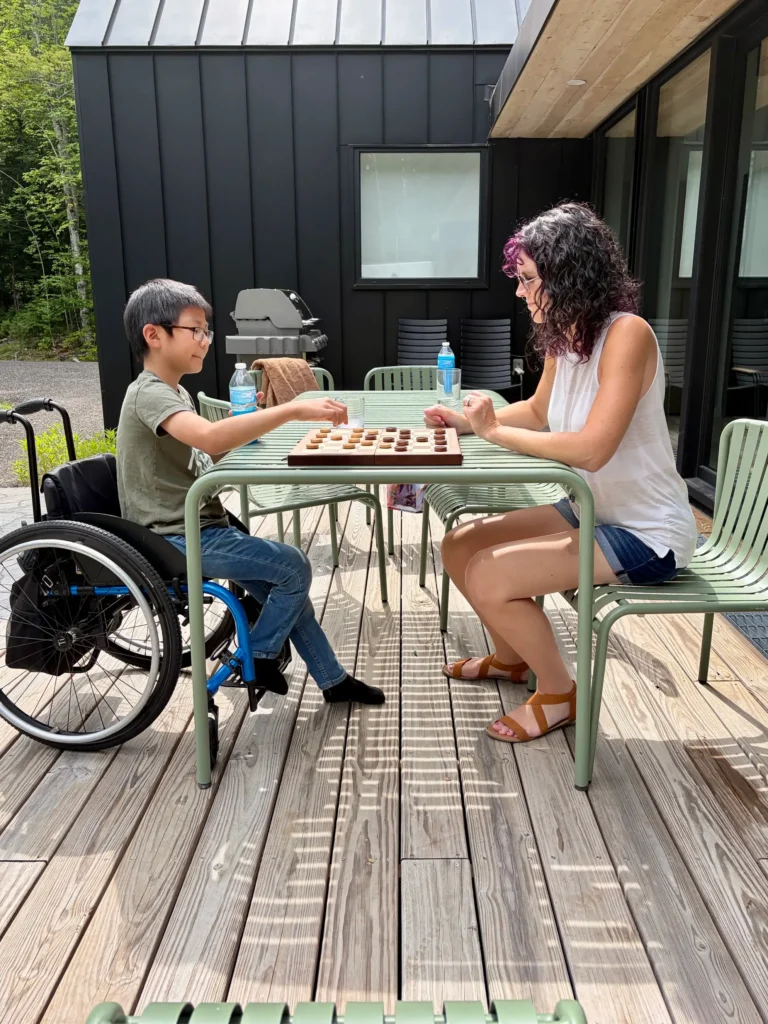
This was a unique stay. Our ten-year-old son with Spina bifida was able to have his own room. He could lower the bed to transfer on his own, and I could raise it to take care of medical routines without having to bend low. He could navigate the bathroom completely independently and didn’t need Mom to move the showerhead or pass him shampoo. We skipped so many extra steps that, while they’ve become normal, add a level of work and fatigue to a trip.
Even at home, bedtime routines mean several runs up and down the stairs for Mom. Here, we were able to vacation. The kids could run and play, inside and out. We did our own things, we did things together, and we spent a few days doing what I imagine a typical family vacation might look like.

That’s repeatable. It didn’t exhaust my personal natural resources or damage my ability to imagine planning another trip. Places like this, while I appreciate the focus on sustainability for the planet, also make travel sustainable for families like mine.
