
Listen to this Article
At home, I am queen in a kingdom of chaos. We have a nearly exact routine from the moment the kids wake up in the morning right up to the moment we collapse in bed at night. Maybe we’re so consistent because it meets our kids’ neurological needs, but the reality is it also returns a level of control to us as parents.
In a life where there is so little within our control, we have found a way to grasp on to a handful of things and hold them within our power. We haven’t had the luxury of a standard 9-3 school schedule, regular extra-curriculars, or milestones occurring on a standard schedule. We’ve adjusted and modified, building routines that are uniquely ours, and it feels good to have a level of control.
With my first raised in triumph, I feel pretty good about our modified lifestyle. I hold my family in that fist, safe from the endless bumps in the road — both physical and metaphorical.
But a closed fist cannot receive anything new.
Families like mine are missing out. We don’t go out as often, or as far, or stay as long. Why? Because it’s hard. And maybe we are simply tired of mastering new versions of hard.
Have you ever seen Finding Nemo? In the film, the loving, albeit slightly overprotective, dad promises his son that he’ll never let anything happen to him. His dad’s friend, Dori, points out, “Well, you can’t never let anything happen to him. Then nothing would ever happen to him.” How much are we missing because we’re holding on so tightly to the fragments of our lives that we can control?
If freedom requires open hands, travel has to begin with releasing our grip. Here are five things that we need to release in order to have open hands to receive the gifts that flow from a life of adventure.
1. Independence.
I’m going to go ahead and start with the thing we hold most dear, and, therefore, the most tightly. Independence is what we’ve strived for, isn’t it? At home, we’ve set things up for our kids to be as independent as possible. My husband just finished bathroom renovations to widen the door and lower the towel racks and we finally have a ramp out front. I know the joy of enabling a nine year old to be as independent as possible. I also know the trickle down effect on my own independence. I don’t need help at home. I’ve got this. We’ve got this.
That all disappears when we leave our bubble of comfort. I can’t carry my son and his wheelchair up three flights of stairs when the elevator is down. I have to ask for help. My son can’t use an inaccessible restroom on his own. He has to ask for help.
I can’t explain why this is so hard or how we’ve come to believe it’s a deficiency to need help, but I’m certain that my own unwillingness to ask for help is negatively impacting my kids’ ability for the same.
This is the thumb of resistance. The digit that strengthens our grip. Holding on is hurting our perception of ourselves and our children’s perceptions of themselves. Community has always been greater than independence. If we were never meant to do life on our own, what are we missing out on when we insist on doing ourselves? Needing help is not failure. It’s connection. The interconnectedness we experience through travel is one of its greatest gifts, and one of our greatest fears.
2. Routine.
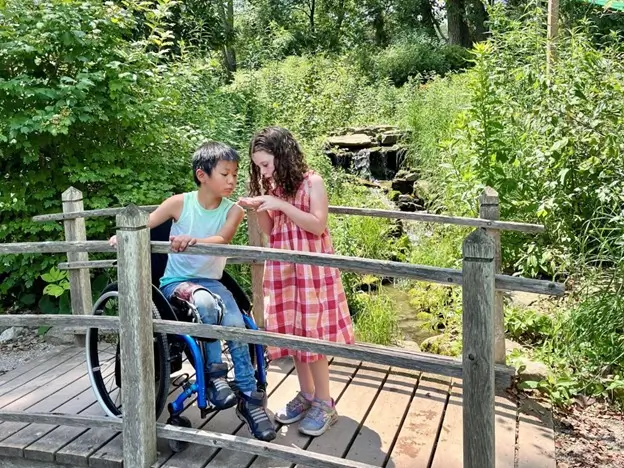
I’ll call this the index finger, because routine is what points us in a clear direction.
I used to think I was spontaneous, but at this phase in life an unexpected visit from an out of state friend would throw me into a tizzy. Do I cancel physical therapy, or miss out on our short time together? I’m going to have to ignore her to get through administering enemas and bladder flushes as it is, then it’s the back and forth of helping with e-stim and getting ready for bed.
The good news is, you will be able to maintain some routine when you travel. Because we’re aware of the needs of neurodiversity, we still wake up and eat breakfast at the same time every day. Then, instead of heading to school, we head out for an adventure. In fact, we still end our adventure as if we’re functioning on a school schedule – so we can do physical therapy in our hotel or rental, eat dinner on time, and get through medical routines before bed. These pieces of routine help many kids to thrive.
It’s important to remember, however, that most of the magic of your trip will live in the slice of your day that is not within routine. This is when you’ll conquer new trails, indulge in new flavors, find joy beyond your limits and have your breath taken away by unexpected wonders. Routine can anchor us. It does not have to cage us.
3. Health.
Surely that was a typo. Health is at the crux of all we do as parents of medically complex children. It’s the middle finger, in keeping with the metaphor. We cannot risk being away from our specialists. Who will take care of our children’s complex needs?
Take a deep breath and let’s be realistic. When have you ever truly been in control of your child’s health? How many times have you ended up in the emergency room while your care team was off for the weekend? Sometimes things go wrong. Sometimes, our children need care that cannot wait. The doctors where you’re visiting are likely just as qualified as the doctors where you live. In fact, sometimes you’ll get lucky with much better care than you can find at home.
Before you leave, ask your doctor who he/she recommends on-location. Your doctor works in a large network of medical professionals and will know your best care option.
When you’re traveling domestically, many scripts can be filled from your destination. Some continuous care, like physical and occupational therapy, can be continued virtually.
Leaving your comfort zone does not mean leaving your safety zone. Have an emergency plan and trust that your skills to navigate hiccups goes with you.
4. Expectations
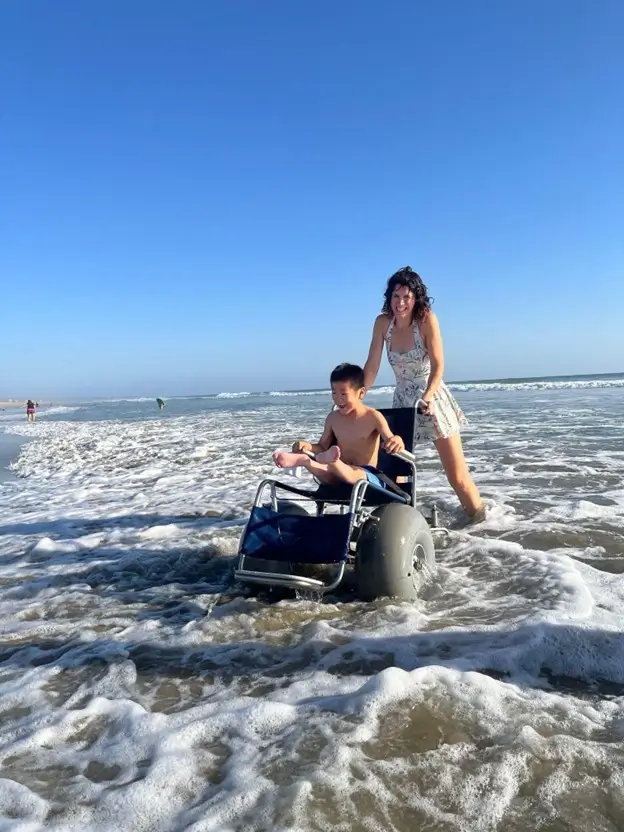
The vision of travel in my head is sitting where the sand meets the sea, the waves gently lapping my toes as I read in the shade of an oversized sun hat. This cannot be my reality. If this is what I head to the beach for, I’m going to be sorely disappointed.
I can have sand and sea, but I’ll be pushing a heavy beach wheelchair, transferring a child in and out of the water, and remaining on high alert to keep children safe while they play.
If that sounds daunting, it’s important to remember that the expectation that travel is solely caregiving is also unrealistic. In the same way that we find moments of joy in caregiving at home, we create special moments when we experience new things together in new places. The beach may not be as relaxing as it used to be, but the sun on your skin and the water on your toes will still feel magical. You may not get to sit with a book, but you’ll splash in the water with people you love – making memories that you never could at home.
We bring our medical routines, mobility needs, and behavioral health meltdowns with us when we travel, but we add in bold adventures, unforgettable meals, deeper connection, and memories that outshine the hard parts. Adjust your expectations, live in the moment, embrace the joy, and push through the caregiver moments that you already push through every day.
5. Control
We’ll call this the pinky, since by now you should have minimal grip left.
This is the culmination of it all. No matter how much you’ve already released, there are still so many things that you’re hanging on to. It’s natural. This life is wild and we can be whipped around unexpectedly at any moment. We’ve got to hold on to something.
Or do we? The longer I head down this road of disability parenting, the more I learn that not only is so little within my control, but the more easily I release it, the better. We cannot thrive when we live in an attempt to control – not at home, or on the road.
The only thing we truly control is our presence and our response.
We can choose to be fully present with the people we love, in the places that bring us joy – in spite of all of the “what ifs” that can spin through our heads at any given moment. We can choose to respond with patience, grace, and joy to the unexpected turns in the journey. When we learn to live in the moment and to release control over all of the things that can hijack our days and our lives, that’s when we begin to embrace the adventure, no matter where we are.
When we loosen our grip, our hands are finally open: to connection, to wonder, to possibility. This is where freedom lives.
