

Listen to this Article

Sleeping Bear Dunes National Lakeshore is known for its sweeping Lake Michigan views, forested trails, sandy dunes, beaches and dramatic overlooks. It is also a place where the landscape itself can create barriers to visitors. The dunes are sandy, the trails can be hilly, rooted and difficult to navigate. Some of the most beautiful parts of The Park, including the beaches and overlooks, can also be some of the hardest places to reach for visitors with mobility issues.
The Bear Tracks Accessibility Program was created to help change that. The free Trackchair program, supported by the non-profit The Friends of Sleeping Bear Dunes, assists visitors with mobility disabilities to experience trails, beaches and views that were once difficult or impossible to access.
Missy Knebel, volunteer program manager for the program shared that the need for Trackchairs was first recognized The Sleeping Bear Dunes National Lakeshore itself. Many trails were not accessible to visitors with mobility issues, so The Park reached out to The Friends of Sleeping Bear Dunes, a separate organization from the National Park, to explore whether a Trackchair program was feasible. The goal was straightforward: open more trails to more people and remove as many barriers as possible including the financial barrier.
Bear Tracks is free for visitors because, Missy says, “finances” should not stand between someone and the chance to experience the beauty of The Park. “We want to open our trails to all,” she says. “That was the point of the entire program, to limit barriers to those who wanted to access the trails.”
The program began with one Trackchair on one trail. It has since grown to three Trackchairs and multiple trail experiences, each offering a different way to experience Sleeping Bear Dunes National Lakeshore.
One experience is the Railroad Grade Trail in the southern part of The Park. It follows an old railroad line through a hardwood forest, over small dunes and out to the beach. The Trackchair can go all the way to the edge of the water, although it cannot enter the water because the batteries and electric motor are located underneath the chair. The trail is an “in and out” experience, meaning visitors travel straight out and return along the same route. It is flat for much of the way and leads to one of the park’s most meaningful payoffs: Lake Michigan . . . sand, water and open shoreline.
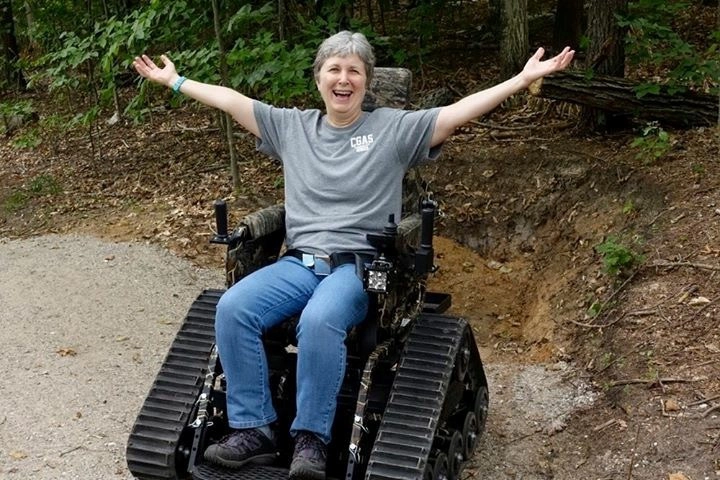


The other Trackchair experience is now at the popular Alligator Hill Trail, a three-mile loop in the northern part of The Park. The route takes visitors up to a hilltop with a magnificent view of Lake Michigan and the Manitou Islands before returning to the trailhead. The move to Alligator Hill was made possible by adding solar-power to the Trackchair trailer. Because the new trail location did not have electricity, The Friends of Sleeping Bear Dunes added solar power to its trailer so two Trackchairs can be charged and housed at the new site without the addition of electricity.
The Trackchair reservation process is designed to be simple. Visitors go to The Friends of Sleeping Bear Dunes website (www.friendsofsleepingbear.org) and open the Accessibility page, where they can find information about Trackchair locations, chair sizes, weight capacities and available trails. From there, they choose a date, time and trail using an online calendar system. The form asks for basic contact information and some questions about mobility needs so the team can prepare for safety and comfort. A waiver is also completed online.
At the trailhead, visitors are met by a volunteer host. The host instructs the user how to operate the Trackchair, which is controlled by a joystick. Once the visitor is comfortable operating the Trackchair the group heads out on the trail.
The host’s role is intentionally supportive without taking over. Some stay back and remain outside the experience unless needed. Often, they are invited to hike along with the group. Their job is to help if there are questions or difficulties, while allowing the visitor and their companions to experience the trail as independently as possible.
The Trackchair experience usually lasts about an hour and a half once the group gets going. Afterward, the visitor leaves and the host cleans and stores the equipment, making it ready for the next user.
Volunteers receive formal training in the spring before the Trackchair season begins, along with one-on-one training throughout the season if needed. They learn how the chairs function, how to complete safety checks, check the batteries and joystick, how to use bolsters (if they are needed), harnesses and other supports so each visitor is safe, secure and comfortable.
They also ride in the Trackchairs themselves. As a group, volunteers take the chairs onto the trails, so they understand what it feels like to navigate roots, puddles and uneven ground. New hosts may also shadow seasoned volunteers during their first outings.
Safety is one of the most common concerns visitors have before booking. People often ask how rough the trail will be, how secure they will feel, how fast the chair goes and how easy it is to drive. Missy says most people become comfortable with the Trackchair quickly. “It does not matter if they are 10 years old or 95 years old,” she says. “They are soon comfortable with the chair and ready to hit the trail.”
She says the reactions of the Trackchair users are unforgettable. Visitors who once thought a beach, a lookout or a forest trail were out of reach have responded with smiles, tears, laughter, awe and gratitude.
“If I had to pick one word, it would be happiness,” she says. “The smiles are unbelievable.”
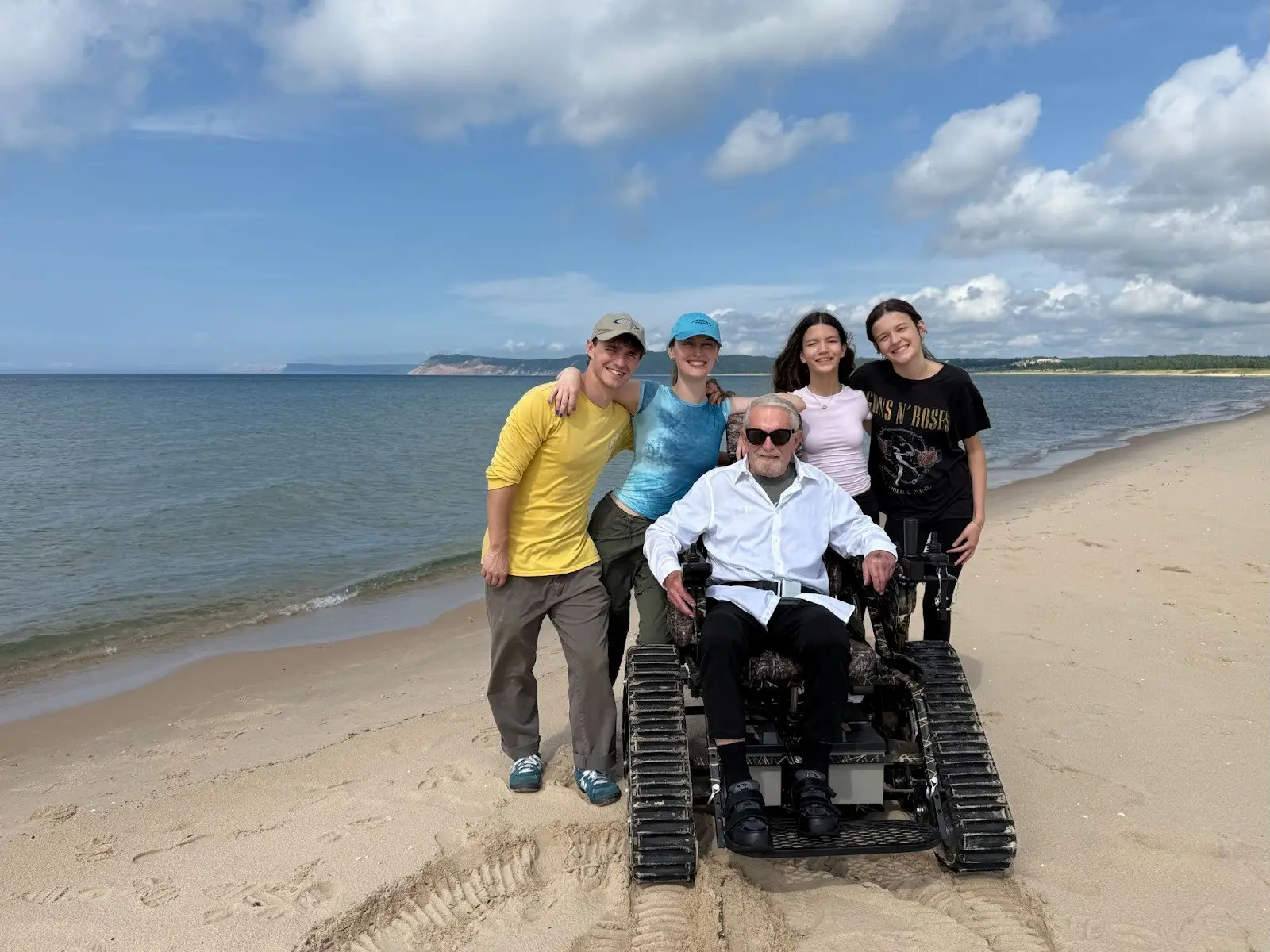
Many hosting experiences stay with her. One involves a dear friend whose husband was in the end stage of Alzheimer’s disease. He loved the outdoors and at one time headed up a hiking group himself. He drove the Trackchair by himself along the Railroad Grade Trail, accompanied by his grandchildren, all the way out to the beach. His granddaughters later said the experience was life-changing for him. For years, his disease had taken away control and he depended on others for care. But that day, he controlled the chair. He chose where to go, how fast to travel and how long to stay.
“On that day his life had returned to normal because of what the Trackchair could provide for him,” Missy says.
Another story involved a family that camped every year at Platte River campground and always took a family hike with grandparents, parents and children. Unbeknownst to the entire family at the time of the hike the Trackchair user had been diagnosed with terminal cancer. That hike would be his last. The Trackchair allowed the family to share that final trail experience together.
“The fact that we were able to offer that experience to them was very gratifying,” Missy says.


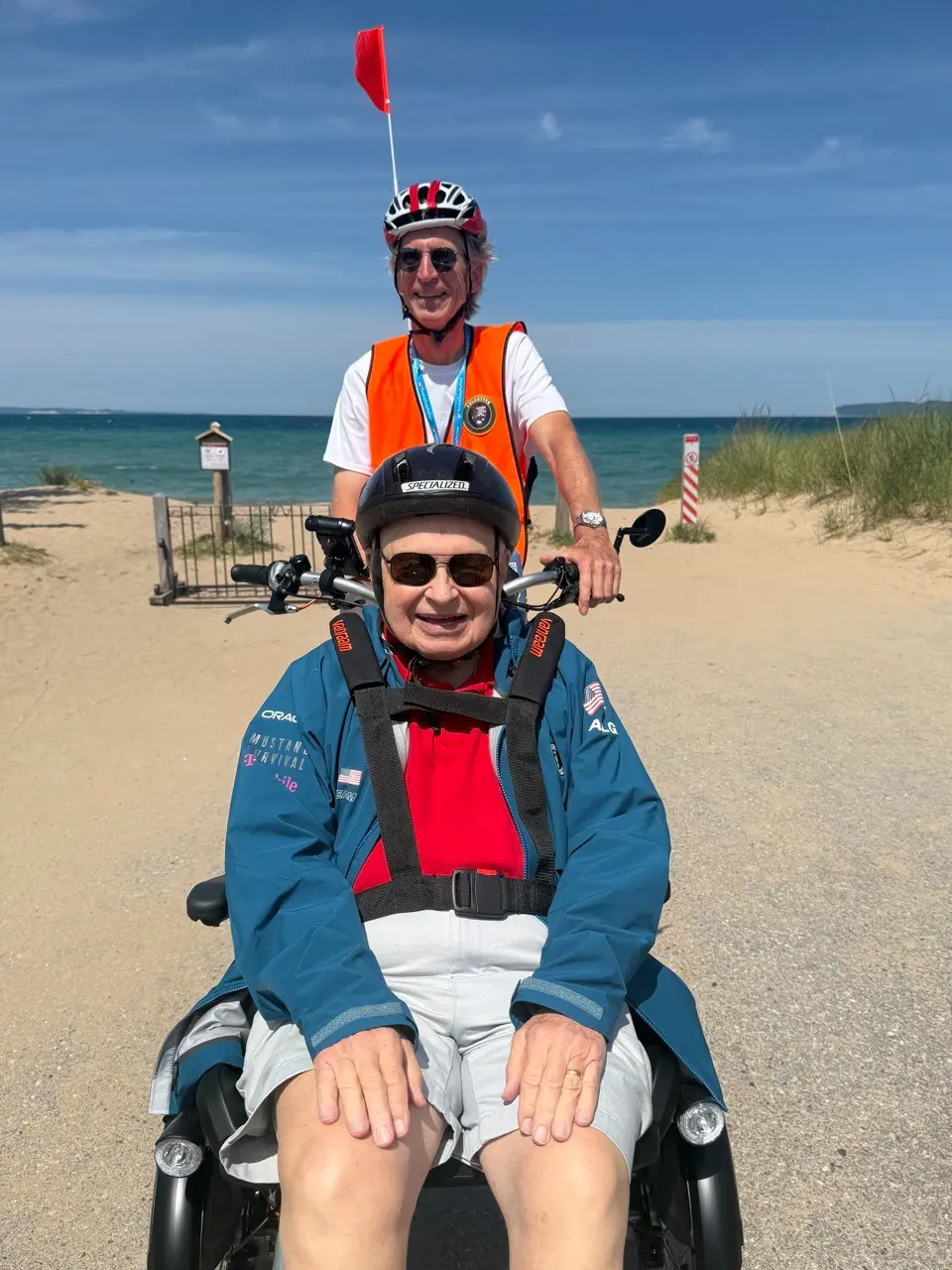

Bear Tracks is one part of a growing accessibility effort at Sleeping Bear Dunes. The Friends of Sleeping Bear Dunes has also introduced what it calls its Adaptable Wheelchair Bike program. Missy explained that it is an adaptable chair mounted in front of an e-bike. The visitor sits in the front with footrests, armrests and a harness, while a trained host pilots the bike from behind. A second volunteer rides ahead as a safety rider to clear the path.
The Wheelchair Bike operates on the Heritage Trail. It begins at the Dune Climb, travels to the historic village of Glen Haven, reaches the beach, continues through the woods toward the town of Glen Arbor, and then returns. The trip is about eight miles and lasts around an hour and a half. Companions are welcome to ride along on their own bikes or borrow bikes from the nearby Dune Climb Inn free of charge.
Other accessible options, including sand wheelchairs and an accessible kayak launch, belong to The Park itself rather than The Friends of Sleeping Bear Dunes. The sand wheelchairs are available at the Maritime Museum in Glen Haven on a first-come, first-served basis from 11 a.m. to 5 p.m., seven days a week, with a driver’s licence. The accessible kayak launch is on Loon Lake and is also free to use.
Planning ahead, The Friends of Sleeping Bear Dunes wants to grow its programs, add more trail options and reach more people. There may also be future opportunities to support access beyond hiking, such as helping children join school trips in The Park or assisting people who need to reach an event such as a beach wedding from a parking area.
That growth begins with visitors knowing the program exists and learning about what is available. Go to The Friends of Sleeping Bear Dunes website, learn about the program, look at the photos and see the smiles.
The beauty of Sleeping Bear Dunes has always been there, but Bear Tracks helps make sure more people can experience it. Across the sand dunes, a forest trail to hilltop views and the Lake Michigan shoreline, the program is opening paths that once felt out of reach; one Trackchair, one volunteer and one unforgettable smile at a time.