
By Sumaira Latif

Listen to this Article

Sumaira Latif is Company Accessibility Leader at Procter & Gamble (P&G), where she drives inclusive design in products and advertising across global brands. As a blind advocate for accessibility, she brings lived experience to her work, helping create products that are easier to use for all, including in everyday travel experiences.
This first-person story reflects the lived experience of the author and is presented in their own words.
Traveling always brings the excitement of discovering a new destination, especially for the first time. For me, that excitement is always mixed with a bit of trepidation as I figure out how to adapt to an unfamiliar environment, its cultural norms, and potential language barriers. And often, that challenge shows up in the most ordinary products, as I discovered on a recent trip to Tokyo.
I walked into a store to buy a bottle of shampoo and was confronted by a wall of refill packages. While that’s wonderful for the planet, I realized that most of the refills felt identical in shape and size, whether it was for dish soap or shampoo. For a sighted person, the visuals on the pack might offer enough clues, even if they can’t read Japanese. But for me, it was impossible to identify what was inside.
By contrast, moments later I walked into a home department store where many products were unboxed. There, I could feel the beautiful vases and plates in different shapes and sizes. The experience was wonderfully tactile and intuitive, and I could easily choose a few gifts for my friends and family. It was a clear reminder of how thoughtful design can either create a barrier or invite you in.
Last summer offered a very different kind of moment, one that showed how design can support independence in a shared setting. On an extended family trip to Orlando, we were all staying in a large villa and had brought several boxes of cereal with us. One morning, while everyone else was still asleep, I wanted to have some cereal but needed to find the healthiest option. I knew that the Kellogg’s boxes we had contained a NaviLens code. I opened the cupboard, scanned the shelf with the NaviLens app on my phone, and my phone read out the names of each of the cereals, along with the nutritional information. I was able to choose the corn flakes independently and quietly, without needing to wake anyone up for help or stick my fingers in boxes to try the cereal before using it.
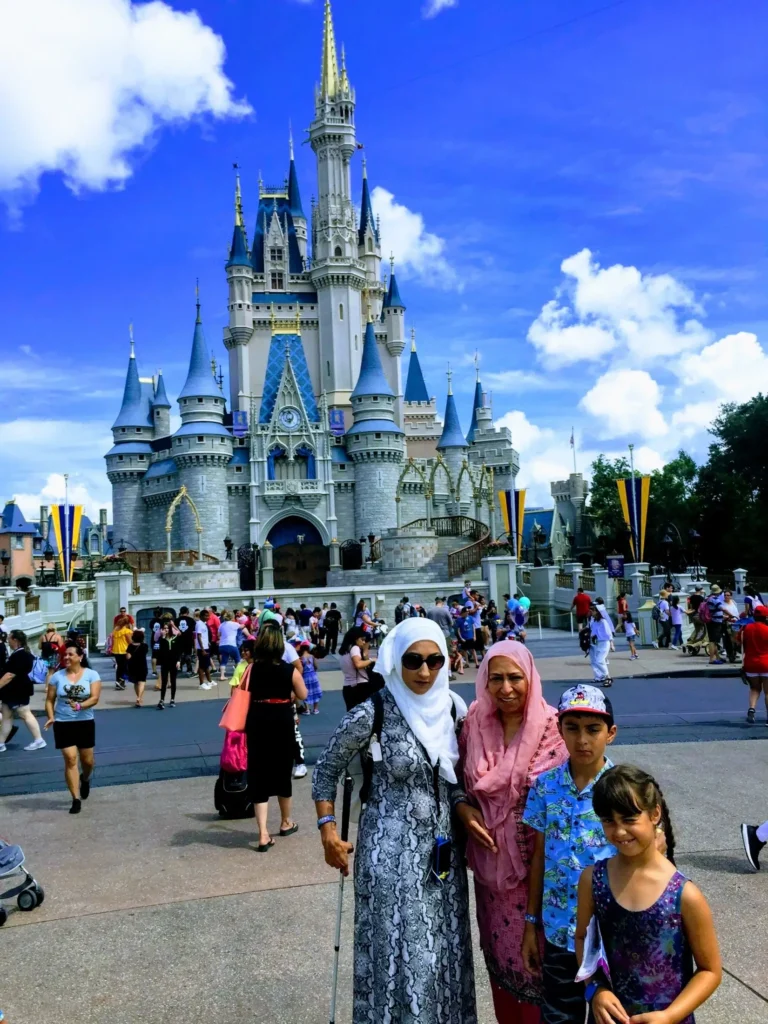
Perhaps the most impactful inclusively designed product I use is my Apple iPhone. It’s my gateway to the world through apps like Be My Eyes, Aira, and my Meta glasses, connecting me to volunteers or AI that can describe my environment. It also allows me to collaborate in unique ways. My mum can’t read English well, so on a trip to Disney, we made a great team. I used my phone’s audio navigation to guide us to the local supermarket, and when we got close, she spotted the entrance and found a shopping cart. Later, when we couldn’t tell the difference between full-fat and low-fat milk, I simply used the Be My Eyes app to have a volunteer read the labels to us.
These principles of making products easy to find, identify, open, use, and read show up constantly in my travels, especially in their absence. This is particularly true when I travel by myself. While I can prepare my own things, it’s the local, unfamiliar items in a hotel room, like the air conditioner controls or the different flavours of tea, that can be super challenging.
My solution has often been technology. I can use an app like Be My Eyes to make a one-way video call to a sighted volunteer who can see through my phone’s camera and read me the information I need. More recently, this has evolved with my Meta glasses. The real advantage is being hands-free. I can call a volunteer to describe my surroundings while using both hands to adjust the air conditioner settings or pick up different tea bags with ease.
Inclusive design is not a nice-to-have. It is essential.

If these products were designed inclusively from the start, I could simply get the job done much faster. Asking for help, whether from a person or an app, adds a layer of effort and time that can become exhausting over the course of a trip.
I saw the impact of thoughtful design in a different way at a disability conference in Florida. We brought stickers featuring P&G’s tactile symbols to raise awareness among delegates. The system was simple: stripes for cleaning, one stripe for body wash, two for hand wash, four for shampoo. Circles for moisturizing, one for face moisturizer and eight for conditioner.
The response was incredible. People took the stickers back to their hotel rooms and applied them to the products. I did the same, and it was so helpful to know with confidence which product I was using each day. It was a small intervention, but it sparked interest from the hotel itself, which began exploring the possibility of adding tactile features to their own products. It showed how a simple idea can create a ripple effect.
Intergenerational travel often highlights both independence and interdependence. I experienced this on a family trip to Disney years ago. It was me, my husband, my mum and my three very young kids. In many ways, we were all relying on each other.
When products were not designed accessibly, that reliance turned into a chain of dependence. I couldn’t identify what something was, so I relied on the kids. My mum couldn’t open certain products. The kids needed help dispensing the right amounts. There were moments where I felt inadequate, unable to help my own family with the simplest of tasks because I didn’t know what a product was or how to use it. You can be confident and capable in your work yet find yourself unable to identify something as basic as what’s in a jar. It’s a humbling reminder that inclusive design is essential.
At the same time, familiar systems can restore independence. I always travel with my make-up, but I’ve had to make it accessible myself. I use three different eye shadow colours and distinguish them with simple adaptations: one elastic band on the first, two on the second, and none on the third. Because of this, I can do my make-up just as quickly and confidently in a hotel room abroad as I would at home. That small routine makes an unfamiliar environment feel more manageable.
Intergenerational travel can really highlight our vulnerabilities and interdependencies.
When products are not designed inclusively, it often affects whether I choose to use them at all. You become hesitant to ask for help because you don’t want to be a burden. Your family is on holiday too, and it’s not their role to assist you because a product is inaccessible. Sometimes, I simply go without. I’ve stood in hotel shops wanting a drink, but if all the bottles feel the same, I’d rather not take the risk. Over time, you learn to budget your requests for help, saving them for what truly matters.
When products weren’t accessibly designed, it created a chain of dependence.
Having children has made this even more apparent. Adults will usually help, even when they are busy. Children, on the other hand, will honestly tell you when they’ve had enough. When products aren’t accessible, my role can shift from full participant to someone who is constantly asking for help, and that changes the dynamic within the group.
Looking back, it’s often the smallest design details that have the greatest impact. I remember visiting Camden Market in London with my kids. It’s a vibrant and busy place, full of shops and food stalls. My Meta glasses described my surroundings using AI, which meant I didn’t have to rely on my kids to guide me. Instead, they could lead the way naturally, pointing out things that interested them. Sometimes I would even surprise them by sharing something the AI had just described to me. It became a shared experience, balanced and engaging. Moments like this can feel seamless, but they are often balanced by small, unexpected challenges. Normally, I use Apple Pay, but on that day my phone battery died, and I had to use cash. I was able to distinguish between £10 and £20 notes because of the tactile markings on UK currency. That small design detail allowed me to continue participating fully, buying treats for my kids without needing help.
These kinds of inclusive systems also affect the pace and flow of travel. In airports, for example, accessibility services allow my mum to use a wheelchair while I have a guide, leaving my husband free to focus on the kids. When systems are designed to support different needs, everything moves more smoothly. When they are not, everything slows down and creates friction.
Emotionally, these experiences can be draining. Each barrier is a reminder that your independence wasn’t considered. Socially, it can make you feel like you are creating extra work for others or even holding the group back. That is why moments where design works well, or where technology supports independence, are so powerful. They allow me to stay present, engaged, and fully part of the experience rather than dependent on it.