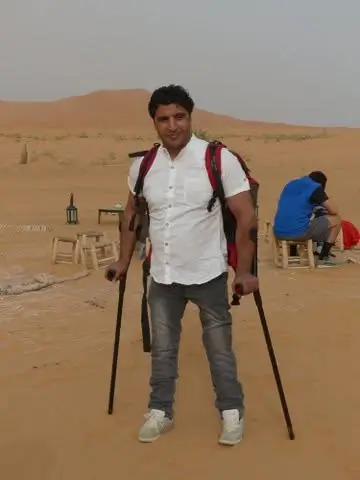

By El Houssaine Ichen, Disabled Tourist Guide, Marrakech, Morocco

Listen to this Article
A typical day in Marrakech from morning until evening

For me, Marrakech is a city that begins early. A typical day might start with meeting visitors at their hotel and making sure everyone is comfortable before we begin. I like to take the morning at a relaxed pace, because accessibility is not only about whether a place can physically be reached, it is also about giving people enough time to enjoy it without feeling rushed.
We might begin with some of the historic areas of the city, visiting places such as the Koutoubia area, the medina, traditional markets or one of the city’s gardens. Along the way, I explain not only what visitors are seeing, but also what they should expect from the surfaces, traffic, crowds and entrances.
Around lunchtime, I like to find somewhere where visitors can sit comfortably and take a break. In the afternoon, depending on the visitor’s energy and interests, we might continue exploring the historic city, visit a quieter attraction or spend time experiencing Moroccan culture and food.
By the evening, Marrakech becomes particularly lively. The atmosphere changes, especially around Jemaa el-Fnaa. I want visitors to experience that atmosphere, but I also make sure we choose the right location and timing for their individual needs.
There is no single “perfect” Marrakech itinerary for a disabled traveller. I believe the day should be adapted to the person.
Routes I chose to take with visitors
I choose routes according to the individual traveller rather than following exactly the same itinerary every time. I consider whether someone uses a manual or powered wheelchair, has limited mobility, becomes tired easily, has difficulty with uneven surfaces, or needs quieter surroundings.
Where possible, I prefer routes with more manageable surfaces, fewer unnecessary steps, places to stop and rest, and easier access to vehicles. I also try to avoid putting visitors into situations where they have to repeatedly negotiate very narrow or crowded passages.
One of the advantages of having lived with a disability myself is that I understand that a route which looks short on a map may be very different for someone using a wheelchair or walking with limited mobility.
For me, a good accessible route is not necessarily the shortest route. It is the route that allows the visitor to enjoy Marrakech safely, comfortably and with dignity.
What visitors should know about the medina
The medina is absolutely worth experiencing, but visitors should know what to expect.
The surfaces can be uneven, and there are narrow passages, changes in level, steps and areas where movement can become difficult. There can also be many pedestrians, motorcycles, bicycles and delivery activity, particularly at busy times.
For a wheelchair user, these conditions can make independent movement difficult. Some entrances to traditional buildings or shops may also not be accessible.
I therefore recommend that disabled visitors do not assume that everything will be accessible simply because a place is a major tourist attraction. Planning makes a big difference.
I accompany visitors through the areas that are most appropriate for them and adapt the route when necessary. Sometimes this means taking a slightly longer route, visiting at a quieter time, or deciding that a particular entrance or attraction is not suitable.
The medina should not be seen as impossible for disabled travellers. It simply requires preparation and realistic expectations.

Parts of Marrakech that’s easier to navigate for wheelchair users or people with limited mobility
Some newer or more open areas are generally easier to navigate than the older parts of the medina because there is more space and fewer architectural barriers.
Wide streets, smoother surfaces, accessible entrances, convenient vehicle access and places where someone can stop and rest all make a significant difference.
The challenge in the historic areas is that the architecture was created long before modern accessibility standards existed. Narrow streets, steps and uneven traditional surfaces are part of the character of the old city, but they can also create real barriers.
This is why local knowledge is important. Accessibility is sometimes about knowing which entrance to use, where a vehicle can stop, which street is easier, or when a particular area is less crowded.
Obstacles disabled visitors encounter most often in Marrakech
The obstacles I see most often include uneven surfaces, steps, narrow entrances, crowded streets, motorcycles in pedestrian areas, limited accessible toilets and transportation that is not always designed with wheelchair users in mind.
Another challenge is information. Visitors may not know in advance whether an attraction has steps, whether a bathroom is accessible, or how far they will actually have to travel on foot.
I try to solve these problems before they become problems. I speak with visitors about their mobility and requirements before the tour and plan around those needs.
During the tour, I constantly adapt. We can change the route, take a break, use a vehicle when appropriate, or spend more time at an accessible location rather than trying to force an itinerary that is not working.
My role is not simply to show people places. It is to help them experience those places in a way that works for them.
Places in Marrakech I enjoy introducing to disabled visitors
I enjoy introducing visitors to the different sides of Marrakech: its historic architecture, gardens, markets, food, crafts and everyday life.
The Koutoubia area is important because it gives visitors a strong sense of the city’s history and identity. I also enjoy gardens and quieter spaces where visitors can slow down and enjoy the atmosphere without constantly navigating crowds.
The medina can also be very memorable when it is approached with the right preparation. For someone who may have worried that they would not be able to experience it, being able to discover its colours, sounds, architecture, crafts and people can be very meaningful.
I also like introducing visitors to Moroccan culture through food and local experiences. Accessibility should not mean removing the cultural experience. The goal should be to find ways for people to participate in it.
Practical details disabled travellers should know about before they arrive
I always encourage disabled travellers to discuss their specific requirements before arriving.
They should think about the type of wheelchair or mobility aid they use, how much walking they can comfortably manage, whether they need step-free accommodation, and what kind of bathroom facilities they require.
Transportation is another important consideration. A standard taxi is not necessarily suitable for every wheelchair user, particularly for someone who cannot transfer out of their wheelchair. Transport should therefore be arranged according to the person’s needs rather than assumed to be accessible.
I also recommend breaking sightseeing into manageable sections. Marrakech can be stimulating and tiring, especially in warm weather and busy areas, so having opportunities to sit, rest, drink water and take a break is important.
Most importantly, travellers should ask specific questions before booking rather than relying only on the word “accessible.” Accessibility can mean very different things to different people.
Changes required to make it easier for disabled residents and visitors to experience the city independently
There are many things that could make a difference.
More continuous accessible pavements would help, particularly where pavements currently change suddenly or are blocked by obstacles. More step-free entrances to public buildings, attractions, restaurants and shops would also improve independence.
Accessible public toilets are important, as are clearly marked accessible parking and drop-off areas.
I would also like to see more accessible transportation options and better information about accessibility before people arrive. If a visitor can find accurate information online about entrances, toilets, distances and surfaces, they can make informed choices.
Accessibility should also be considered when streets and historic areas are renovated. Preserving Marrakech’s heritage and improving accessibility do not have to be opposing goals. With thoughtful design, both can be considered.
Other disability needs Marrakech should consider
Accessibility is much bigger than wheelchair access.
For blind and low-vision travellers, clear information, safe pedestrian routes, tactile guidance where appropriate and information that can be accessed through audio or other formats can make a major difference.
For Deaf visitors, accessible communication is important. Information through text, visual signs and, where possible, sign-language support can make experiences much easier.
For neurodivergent travellers, the environment itself can sometimes be challenging. Crowds, noise, strong smells, unpredictable situations and a very busy sensory environment can be overwhelming. Having quieter alternatives, clear information and the possibility of taking breaks can help.
I think the most important principle is to ask people what they need rather than assuming that every disabled person has the same requirements.
I want to tell disabled travellers
. . . that Marrakech is possible, but preparation is important.
Do not expect the city to be accessible in exactly the same way as a modern city designed around universal accessibility. At the same time, do not assume that being disabled means you cannot experience Marrakech.
There are challenges, but there are also many experiences that can be adapted. The key is to be honest about your requirements and to plan with someone who understands both the city and accessibility.
I know from my own experience that sometimes the biggest barrier is uncertainty. When you know what to expect, you can make better decisions and enjoy the experience with much more confidence.
I would encourage disabled travellers to come with an open mind, communicate their needs and allow themselves enough time to experience the city at their own pace.

What Marrakech already does well when it comes to welcoming disabled visitors
One of Marrakech’s strengths is its hospitality. People are generally welcoming and willing to help, and that human side of the experience can be very important.
There is also a growing awareness of accessible and inclusive tourism. More tourism professionals are becoming familiar with the needs of disabled travellers, although there is still work to do.
Another strength is the variety of experiences available. A visitor does not have to depend on one type of attraction. Marrakech offers gardens, architecture, food, crafts, cultural experiences and opportunities to meet local people. This makes it possible to build an itinerary around the individual traveller.
I also believe that having disabled people involved directly in tourism is valuable. We can bring a perspective that cannot be replaced simply by reading accessibility guidelines.
Can Marrakech become a city without limits?
For me, a “city without limits” does not mean that every historic building or every street becomes physically identical to a modern accessible building. It means that disabled people can participate in city life without constantly having to ask, “Can I get there?” or “Will I be able to use this place?”
I would like to see a Marrakech where accessible routes are clearly identified, transportation options are available, public toilets are accessible, information is easy to find, and tourism professionals understand different disabilities. But accessibility is also about attitudes. A city without limits is a city where disabled people are seen as travellers, residents, customers, professionals and members of the community, not simply as people who need assistance.
My hope is that Marrakech can preserve the character and history that make it special while becoming easier for everyone to experience.
As a disabled person and a tourist guide, I believe accessibility should not be an afterthought. It should be part of the way we imagine the future of tourism in Morocco.