
Listen to this Article
Companions & Caregivers
Supporting every journey together
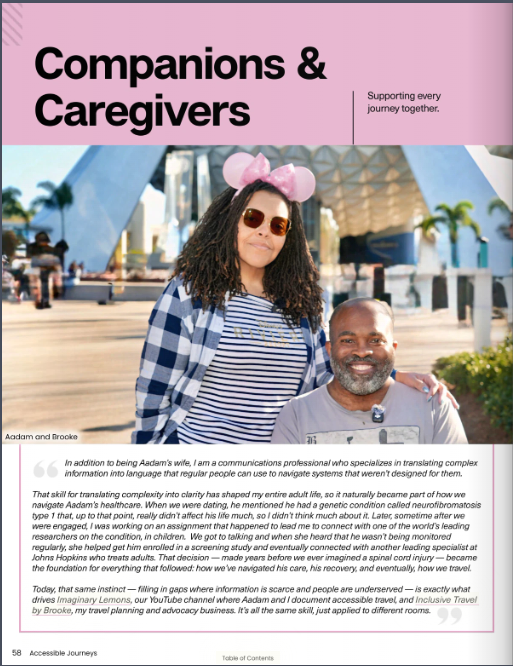
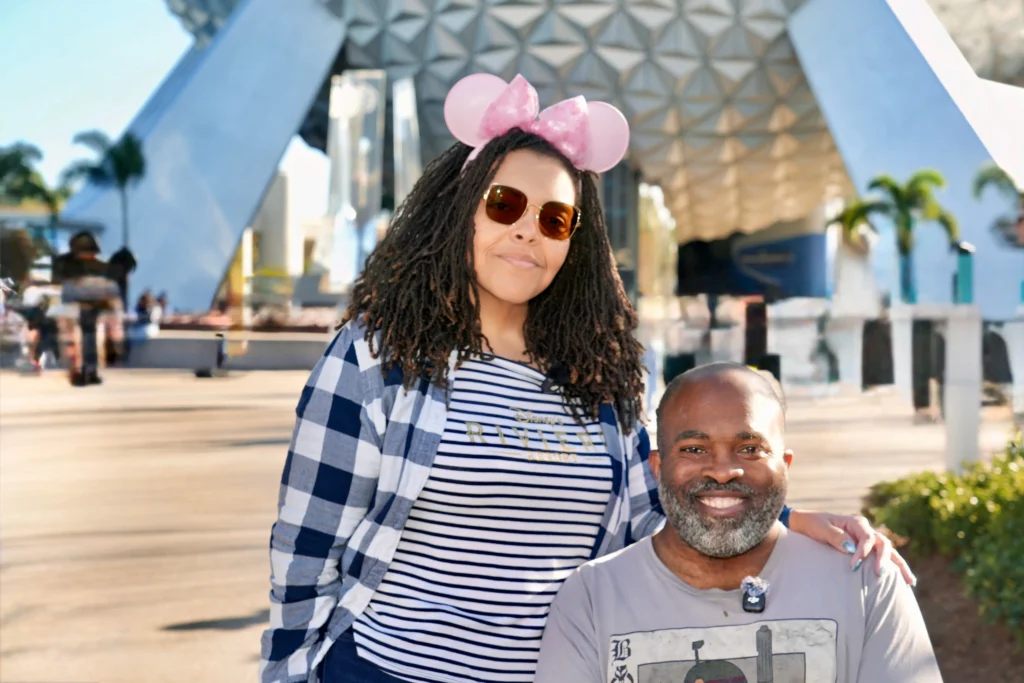
“In addition to being Aadam’s wife, I am a communications professional who specializes in translating complex information into language that regular people can use to navigate systems that weren’t designed for them. That skill for translating complexity into clarity has shaped my entire adult life, so it naturally became part of how we navigate Aadam’s healthcare. When we were dating, he mentioned he had a genetic condition called neurofibromatosis type 1 that, up to that point, really didn’t affect his life much, so I didn’t think much about it. Later, sometime after we were engaged, I was working on an assignment that happened to lead me to connect with one of the world's leading researchers on the condition, in children. We got to talking and when she heard that he wasn’t being monitored regularly, she helped get him enrolled in a screening study and eventually connected with another leading specialist at Johns Hopkins who treats adults. That decision — made years before we ever imagined a spinal cord injury — became the foundation for everything that followed: how we've navigated his care, his recovery, and eventually, how we travel. Today, that same instinct — filling in gaps where information is scarce and people are underserved — is exactly what drives Imaginary Lemons, our YouTube channel where Aadam and I document accessible travel, and Inclusive Travel by Brooke, my travel planning and advocacy business. It's all the same skill, just applied to different rooms.”
General Experience
Describe your overall experience when travelling with Aadam
Travel has always been core to who we are as a couple — we love new places, new food, new cultures. As Aadam’s mobility declined, cruising became our easiest way to keep doing that, since our accommodations move with us. But when he had his spinal cord injury, everything stopped. For a long time, I genuinely didn’t know if we’d travel again. Life shrank down to doctor’s appointments and physical therapy — and staying inside our safety bubble.
Right before the pandemic, we tried a test run: one night at a hotel thirty minutes from home, our first time booking a wheelchair-accessible room. At first, things were going smoothly and we made it through the night without issue, but then disaster struck — his chair malfunctioned and he was thrown to the ground. I went into action mode, found help to get him up, made sure he was okay, and then we went to breakfast as planned. Sitting in the café, drinking coffee and people-watching, I realized how much we’d missed this — not just travel, but simply being out in the world together. And once the adrenaline from the fall wore off, I realized something else: if we could handle the worst-case scenario (him being stuck on the floor), we could handle other things. We didn’t need to be at home to solve problems. That was the turning point.
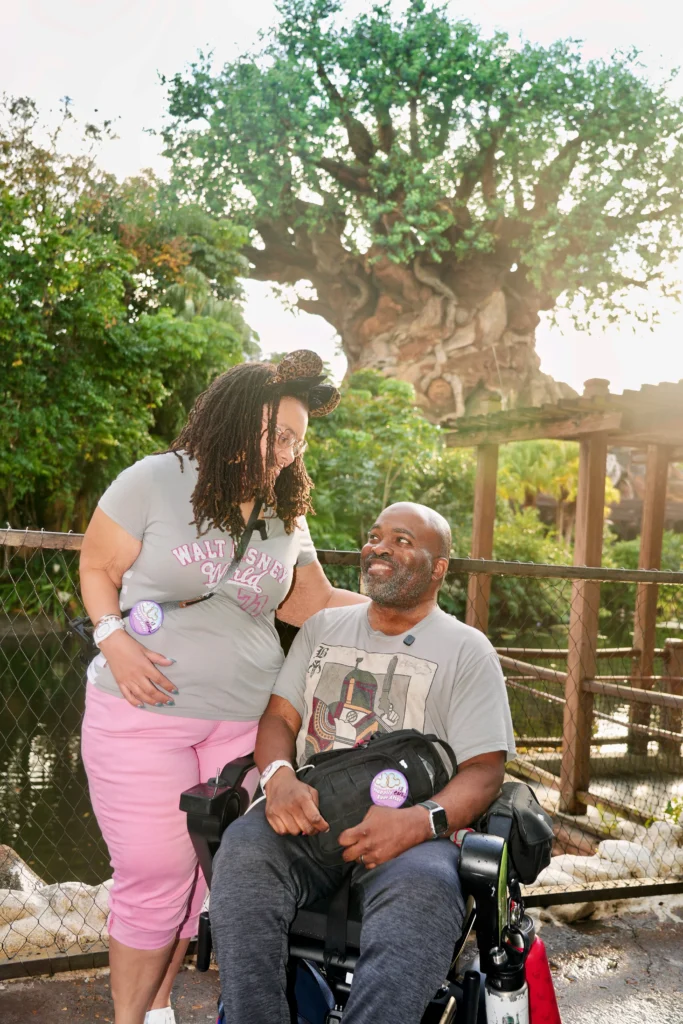
When we finally took a real trip — to Walt Disney World — it changed everything. Disney’s accessibility gave Aadam more independence than he had at home; he could roll to get a snack on his own for the first time in years. And for me, something unlocked too: for the first time since his injury, my primary role on that trip was wife, not caregiver. Travel gave that back to us. It wasn’t until later, once we’d found our footing, that we realized we had a story worth telling — one that could help other people recapture what we had. That’s when Imaginary Lemons and Inclusive Travel by Brooke were born.
How do you prepare for trips?
It starts with a target destination and a hard question: is this something we think can be made accessible? From there I dig into research — YouTube, tourism board websites (which often have dedicated accessibility sections and vendor listings), hotel sites, accessible tour operators, and the work of other accessible-travel creators. I’m looking for proof that people have done this successfully before us or that the infrastructure exists for us to make it work.
Once I’m confident it’s feasible, I lock in a home base, then map out what we actually want to see and do — ignoring the wheelchair entirely at first — before figuring out how to make each piece accessible. I keep a running personal database of accessibility resources: links, vendor contacts, video clips of accessible activities, tucked away for whenever we’re ready to use them. As a triple-certified accessible travel advisor, I also lean on my own vendor network — the same resources I use for clients.
And of course, I have a very thorough packing list, which has been refined over time, to make sure we bring everything we need to make the trip successful.
How do you navigate and choose destinations that are both enjoyable and accessible for your loved one?
My guiding principle, both for us and for my clients, is people first, not chair first: start with what you actually want to experience, then figure out how to make it accessible — rather than starting from what’s easy and working backward. We’re lucky that our natural interests tend to align with things that can be made accessible. But when they don’t — I’ve wanted to do an African safari for years, which isn’t typically framed as accessible — the answer isn’t to give up. It just takes more research, more creativity, and sometimes accepting that accessibility may shape where we go (South Africa versus Kenya, for instance) but doesn’t have to stop us from going.
Our interests happen to align naturally most of the time, which helps. But we also give each other permission to do things separately when they don’t — whether that’s me riding a ride he can’t, or him exploring a port on his own. If something is only mildly important to me and inaccessible for him, I’ll let it go — I’d rather spend the time with my husband. But if it truly matters to one of us, we don’t just accept ‘no.’ We problem-solve.
Responsibilities and Emotional Impact
How do you feel about the level of responsibility you carry while on vacation?
The day-to-day caregiving stays about the same on vacation. What changes is the travel logistics load — airports, luggage, getting from place to place — and that is genuinely harder. I’ve learned I have to acknowledge that honestly instead of just wondering why I’m exhausted. After a solo four-day ‘caregiver getaway’ for my birthday, I realized how much lighter travel felt without those logistics, and I had to work through some guilt about that realization before understanding it’s okay to acknowledge the load and give myself permission to rest from it.
Now, on trips with heavier travel logistics, I build in an extra recovery day, and I always plan a small reward for myself — a nice dinner, a spa treatment — as recognition for the hard parts. I do the hard parts because I love my husband and want these experiences together, but that extra labor is real. It’s part of what I think of as the disability tax: the additional time, energy, planning, and expense required to access experiences that aren’t required for other people. And I know travel days are exhausting for Aadam too. Just acknowledging that in each other — him thanking me for the work, me recognizing what a travel day costs him — makes an enormous difference.
Do you find it difficult to balance caregiving duties with relaxation or leisure activities?
I’m honestly never fully out of caregiver mode, but because Aadam can independently handle most of his daily needs, it’s about finding balance rather than an all-or-nothing switch. At home, if he has time, he does things himself; if we’re time constrained or he’s too exhausted, I step in. That same structure carries over to travel — we build in what we call ‘quad time,’ extra time for him to do things at his own pace, plus contingency time in case either of us isn’t feeling well.
It’s mutually beneficial: he gets to exercise his independence and autonomy, and I’m not carrying the mental load of every task. I try not to treat the extra time as a problem, because that’s simply how some things work for us.
On the leisure side, I make sure to build in real time for myself — sleeping in, a spa treatment, an activity from the cruise planner that Aadam isn’t interested in. That isn’t to say that relaxation only happens away from him. We’re just as intentional about protecting couple time that isn’t about caregiving at all — going to a show together, a special restaurant — because that’s spouse time, not caregiver time. We both give each other space and permission to do things separately, too. Aadam loves exploring ports and wandering beyond the typical tourist areas to see what he finds; I prefer going to a predetermined, thoroughly researched destination or activity. But I love hearing his stories when we come back together — the random things he discovered on his own, the hijinks that almost always ensue. That sharing brings us closer.
How does travelling with Aadam affect your own experience of the vacation?
Travelling with Aadam absolutely changes my experience — but not because he uses a wheelchair. It changes because I’m with him. We see places differently together, we discover things we wouldn’t separately, and there’s a real richness in that shared experience. Yes, the logistics are harder and require different planning. But that trade-off — experiencing the world with my partner, watching him light up when he discovers something new — is worth it.
Do you ever feel overwhelmed by your caregiving responsibilities while travelling? How do you manage those feelings?
Absolutely — especially at airports. Between the extra TSA screening, managing the luggage, and the internal pressure not to be ‘in the way’ or hold up the line, it adds up. I remind myself that we have just as much right to take up space as anyone else, and I’ve learned to prioritize arriving early to take some of the rush out of the equation.
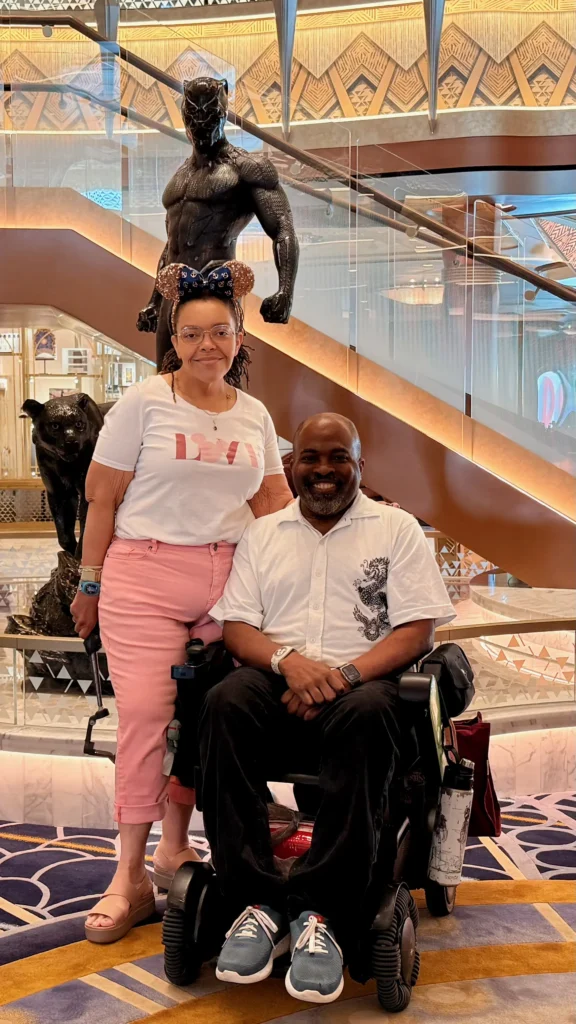
But I can’t predict everything, and when I do hit a wall — like I did getting onto a cruise ship recently, feeling completely emotionally spent for no single identifiable reason — I’ve learned to tell Aadam directly rather than expecting him to just notice, because he’s often overwhelmed too. That day, he suggested we get coffee, which centers me, and I ended up decompressing at a coloring table near the café. He ordered for us and asked a crew member for help brining drinks to the table. That mutual care — noticing each other, and saying so out loud — matters as much as any logistics plan.
Practically, I manage overwhelm by a system I’ve been building since Aadam’s injury: CLEAR the load. First, Clarify the essentials by breaking the situation into the specific tasks that actually need to happen. Then Let go of the optional—the bonuses, expectations, and “shoulds” that may be worthwhile but are not necessary right now. Next, Entrust what others can carry, whether that means assigning a responsibility to someone you love or hiring outside help. Automate what repeats by creating routines, standing appointments, automatic payments, and other systems that remove future decisions from your plate. Finally, Return your attention to what remains: the essential responsibilities that truly need your time, energy, or care.
I’ve automated my packing list, so I don’t have to deal with that nagging feeling that I may have forgotten something important. I entrust Aadam with specific tasks throughout a trip — holding baggage claim tickets, carrying items on his chair, scouting ahead for a taxi stand or the baggage office — choosing responsibilities that are practical for him and meaningfully lighten my load.
Are there moments when you feel like you miss out on certain aspects of the trip?
Not really, because I plan trips around both of our needs from the start and build in enough flexibility to still do what matters to us. When one of us isn’t up for something — illness, fatigue — we weigh how important the thing is against what our partner needs in that moment. It’s not a hard rule that we always do the same things; if I’m sick and Aadam really wants to see a show, I want him to go and come back and tell me about it. Cruising in particular makes this easy, since one of us can rest in the stateroom while the other explores, and we reconnect later. The point is never to check every box — it’s being intentional about the time we do have.
Support and Resources
Do you have access to adequate support while on vacation?
Most of the time it’s just Aadam and me, and I lean on my own research, planning, and travel-agent network to fill in the gaps. But traveling with family recently reminded me how different — and wonderful — it can be to travel with a village. On a recent family cruise, relatives stepped in without being asked: helping disassemble the wheelchair for a taxi ride, helping Aadam into a floating wheelchair to get into the ocean, an experience we couldn’t have managed the same way solo. It deepened our family bonds in a way no holiday dinner ever could. We haven’t needed a hired caregiver, but I know that’s a real option for people who do, and I’d never assume one way is right for everyone.
Have you found any resources or services that make travelling easier for you as a caregiver/companion?
The single most valuable resource is having an advocate — someone who knows where to look, who to call, and who has real relationships with vendors and service providers. That’s exactly why I became an accessible travel advisor: to be that advocate for people who might not have the words to ask for what they need, and to pull together information that is otherwise scattered across dozens of sources. When something goes wrong mid-trip — like a client’s rented wheelchair failing mid-cruise — having a network to mobilize (the equipment vendor, the cruise line, a professional relationship built over years of business) gets it solved fast. The relationships matter as much as the knowledge itself.
Challenges and Solutions
What are the biggest challenges you face when travelling with Aadam? How do you typically address or overcome these challenges?
Before we even leave, the biggest challenge is finding accessible activities in the first place — the information is fragmented and takes real digging. Once we’re traveling, luggage volume is a constant challenge: both of us have medical needs that mean more to pack, and I’m usually the only one who can physically carry it all. Accessible ground transportation has probably been our single biggest recurring challenge.
I try to automate as much of the logistics as I can with pre-planning (scheduled transportation, booking hotels with luggage service), but when something goes wrong, I go back to my CLEAR method.
If our pre-arranged transportation doesn’t come through, can I entrust this problem to someone else – like asking a bellman to help me find back-up transportation and tipping him accordingly? If I’ve clarified that the most important goal is getting from point A to point B and let go of the idea that it must be in a wheelchair accessible vehicle, I can entrust a cab driver and bellman to help me get Aadam’s wheelchair in the back of a regular cab and return my focus to preparing for the next thing.
How do you handle unexpected situations or emergencies during travel? Can you share an example of a time when you had to adapt quickly?
The example I mentioned earlier wasn’t abstract – it really happened. On a trip last winter, our accessible transportation to the airport was taking far too long to arrive, and we were at risk of missing our flight. Using the CLEAR method helped me focus on what was most important, and while the bellman and cab driver got Aadam’s chair in the back of a regular cab, I helped Aadam transfer into the car. Problem solved, panic averted (mostly).
We can’t predict everything, and in those moments, I remind myself that we’ve figured out plenty of things that once felt impossible. Our YouTube channel is named Imaginary Lemons because sometimes life doesn’t hand you lemons — it hands you nothing, and you still have to make lemonade. While it might not always be pretty, families like ours adapt every single day to a world that wasn’t built for us. Everything is figure-out-able.
Personal Reflection
Do you feel that travel provides a break or a change of pace for you? How do you personally benefit (or not) from these trips?
It’s more than a break, though it’s certainly that too. Travel gives us something to look forward to in the middle of hard stretches — during one of Aadam’s hospital recoveries, his physical therapist noted how much having a trip on the calendar made a difference and helped him keep going. Beyond that, travel is joy, connection, cultural perspective, and growth. It genuinely improves my mental health and is core to who I am, both individually and as half of our marriage. It’s not optional for us — it’s essential.
What advice would you give to other caregivers/companions who are hesitant about travelling with their loved one who has a disability?
Do a test run. A controlled, overnight trip close to home — where you’re still near your usual supports — lets you see what actually happens and what supports you are going to need. It can build real confidence before a bigger trip. I don’t think I’d have had the courage to travel again without ours. I’d also encourage connecting with people who’ve done it: a travel advisor with real disability travel experience, or online communities of people who’ve been where you’re going. You don’t have to figure it out alone.
Has travelling with Aadam influenced your perspective on vacations? How has it shaped your understanding of what a vacation means for both of you?
Completely. I used to accept, without really questioning it, that some things just wouldn’t be possible. I don’t accept that anymore. A vacation isn’t a vacation if people are being left out. I think about universal design constantly now — Mobi Mats on beaches, curb cuts on sidewalks, buses that kneel — small design choices made for accessibility that end up making things easier for everyone. That belief now shapes how we travel, how I counsel clients, which vendors I’m willing to spend money with, and what we do with Imaginary Lemons. Everyone deserves the right to travel, full stop.
Relationships and Bonding
How does travelling affect your relationship with Aadam? Do you find that travel brings you closer, or does it create additional strain?
It’s easy, as a caregiver spouse, to get lost in the logistics — medical appointments, equipment repairs — and lose sight of the spouse part of the relationship, especially while staying inside our safety bubble at home. Travel forces us outside that bubble into shared experiences that have nothing to do with disability, and it genuinely strengthens our marriage. Yes, it takes more out of us logistically. But what we gain in reconnection is worth the trade-off, every time.
Have you found any particular activities or destinations that are especially enjoyable or manageable for both of you? What makes these experiences successful?
Disney and cruising are our anchors. Disney has made a genuine, visible effort to build inclusive spaces — physical, cognitive, sensory — and when something does go wrong, I know how to advocate for us and get it resolved. Cruising works because, unlike a hotel, you can book a specific room number and know precisely what you’re getting: which side the grab bars are on, distance from the elevator, a location on the ship. That level of control over the exact details of where you’ll sleep makes a logistically complicated trip so much simpler.
Can you share a memorable experience from one of your trips that highlights both the challenges and joys of travelling together?
On one Disney stay, we arrived to find that our room had been miscoded: it was on the second floor of a building with no elevator, despite being labeled wheelchair accessible. The first alternatives they offered met the accessibility requirement, but not the other features we had booked, including a king bed. I refused to accept the idea that we had to give up our preferences in order to have our accessibility needs met. We had booked both, and I insisted on both. Disney ultimately moved us to a deluxe resort with a king bed and roll-in shower, which was a pretty sweet ending to a very frustrating start.
That experience reinforced something I now remind clients: disabled travelers should not have to trade away comfort, preferences, or value just to receive basic access.
Everything we’ve learned — the strategies, the advocacy, the belief that a vacation should never leave anyone out — drives the work we do through Imaginary Lemons and Inclusive Travel by Brooke. We want other couples, other families, other caregivers to find what we found: the joy of travel, real reconnection, and the confidence that you can do this. Or to put it another way…
Stay strong, get creative, and keep exploring