

Listen to this Article
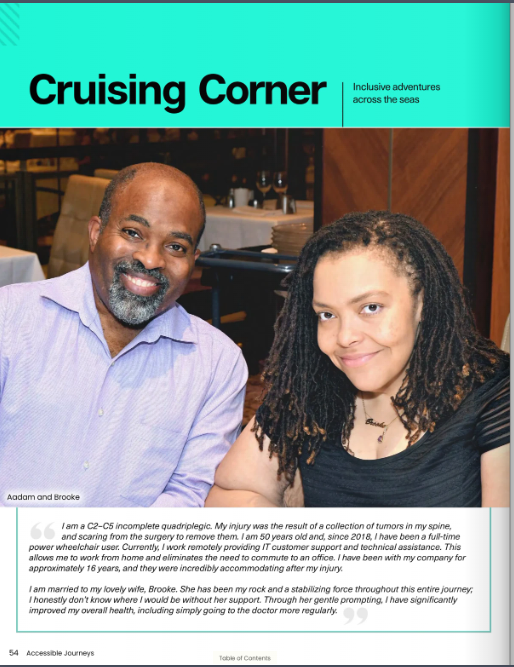
“I am a C2–C5 incomplete quadriplegic. My injury was the result of a collection of tumors in my spine, and scaring from the surgery to remove them. I am 50 years old and, since 2018, I have been a full-time power wheelchair user. Currently, I work remotely providing IT customer support and technical assistance. This allows me to work from home and eliminates the need to commute to an office. I have been with my company for approximately 16 years, and they were incredibly accommodating after my injury. I am married to my lovely wife, Brooke. She has been my rock and a stabilizing force throughout this entire journey; I honestly don't know where I would be without her support. Through her gentle prompting, I have significantly improved my overall health, including simply going to the doctor more regularly.”
Cruises appear often in your travels. What makes cruising work well for you as a disabled traveler, and what should other disabled travelers know before booking their first cruise?
Cruises work exceptionally well for us because they are almost “all-inclusive.” Our lodging, food, and entertainment are all taken care of in one place.
If I could offer one piece of crucial advice to a first-time cruiser, it would be to work with a travel agent who has specific experience booking for travelers with accessibility needs. Every disability is different, so having an experienced professional in your corner can alleviate a lot of anxiety and help you avoid major pitfalls.
I recently saw an example where a disabled traveler booked a last-minute guarantee fare that did not secure an accessible cabin. Because standard cabins often cannot accommodate a wheelchair, the situation became a major logistical problem. It was a good reminder that accessible travel often involves booking details that are not obvious, and an experienced advisor can help travelers understand what is actually guaranteed before they commit.
Disney is known for creating detailed guest experiences, but accessibility can still vary by person. What has Disney gotten right for you, and where do you think disabled guests still need better support or clearer information?
On one of our recent Disney cruises, we ran into a well-known issue for wheelchair users: bed height. The bed in our stateroom was not at an accessible height for a wheelchair transfer. We called and spoke to our stateroom attendant, who reached out to their manager and successfully managed to lower the bed for us. This is an example of something Disney got completely right.
With any vacation provider, open communication is the most important tool for success. Every disability is different, so disabled travelers need to make themselves part of the conversation and be clear about what will and won’t work for them. The company’s role is to listen, understand its own accessibility features, and give the traveler accurate information.
One area they could improve is on their newest private island cruise destination, Lookout Cay at Lighthouse Point. We recently put out a video showing that while they have made some great accessibility improvements compared to when it first opened, there were a lot of ways they could improve. Their beach was “almost” accessible in my personal wheelchair but there was a 3-foot stretch where the sand blows onto the ramp making it impassable. And their signs pointing out the accessible paths are still confusing, though I appreciate that they are hung at wheelchair height.
For disabled travelers who may feel nervous about crowded spaces, long days, transfers, queues, or unpredictable access, what practical advice would you give based on your cruise and Disney experiences?
My first piece of advice to any traveler is to pack your “patience pants.” Travel-induced anxiety is something both disabled and non-disabled people deal with.
Secondly, we highly recommend arriving at your departure city a day early for a cruise or any major travel, for that matter. We know someone who planned to fly out the morning of their cruise departure. This is a risky gamble because travel delays can happen anywhere, from the airline to port traffic to the airport shuttle. Fortunately, she ended up taking our advice and flew in the day before. It was a good thing she did, because her flight ended up being delayed anyway! If she had scheduled her flight for the day of departure, she would have missed the ship entirely.
In addition, for disabled travelers, that extra day gives you time to recover from the travel day before your vacation begins.
What makes a cruise port or shore excursion feel genuinely accessible, rather than just “technically available”?
For us, a genuinely accessible port or excursion relies on crew members who are thoroughly knowledgeable about their specific location. It is incredibly frustrating to arrive at a cruise terminal, ask a crew member for directions to an accessible path, and find out they have no idea.
A truly successful shore excursion is one that is thoughtfully designed from the beginning, featuring seamless curb cuts and clearly marked accessible pathways, proving that inclusion was part of the initial planning rather than an afterthought.
How do you and Brooke plan your days so the trip still feels fun and spontaneous, without ignoring access needs, energy levels, or comfort?
Planning ahead is essential. Knowing exactly what a port offers allows us to relax and have fun once we arrive. For example, when we stop in Nassau, Bahamas, we already know which shops and stops are easy to navigate.
I love to explore whatever city we land in, and I generally prefer to venture past the immediate cruise terminal. Because this can sometimes take me pretty far out, I am always mindful of my surroundings to ensure I don’t accidentally put myself in an unsafe or unreachable location.

If you had to recommend one cruise experience and one Disney experience to disabled travelers, what would they be and why?
Every cruise line caters to a slightly different audience. I started my cruising journey with Royal Caribbean, so they hold a very special place in my heart. The experience on Royal Caribbean is quite different from Disney. Royal Caribbean doesn’t rely on a specific “theme”; instead, it is designed to appeal to a wide variety of travelers.
Disney Cruise Line, on the other hand, is entirely centered around its own brand. To fully appreciate it, you really need to enjoy, if not love, Disney intellectual property. You can have a fantastic time on both, but they are entirely different atmospheres.
As another comparison, Celebrity Cruises tends to cater to a slightly older crowd. While they still have activities for younger guests, we found they offer an excellent variety of live shows, curated excursion experiences, and upscale food options.
What do you wish cruise lines, theme parks, and travel companies understood better about disabled guests traveling with their partners?
When planning any type of excursion or activity, companies must involve disabled individuals or staff members with accessibility expertise right from the design phase. Making an experience accessible should never be a retrofitted afterthought.
Travel companies also need to realize that disabled travelers naturally carry a lot of ambient anxiety about whether their needs will actually be met. Training staff members so they know the exact ins and outs of a ride or shore excursion goes a long way in putting disabled travelers and their partners at ease.
For couples where one person is disabled and one is not, what conversations should happen before a trip so both people feel prepared?
Clear communication is the foundation of any relationship, whether you are dealing with a disability or not. Letting your partner know what is triggering your anxiety makes the planning process much easier.
Once you’ve talked it through as a couple, consult a travel professional who can answer your specific questions and clear up any lingering doubts. Utilizing online travel forums and doing thorough independent research will also go a long way in making sure you both feel prepared.
What is one destination or experience that got accessibility right, and what made it work so well for you?
That is a tough one! Brooke is the master planner who does the bulk of our research. When we went to Alaska a few years ago, she found a glacier helicopter excursion where the tour operator used a specialized lift device to help a wheelchair user safely get into the aircraft. Landing directly on the glacier was an incredible experience. Even though I couldn’t physically step out onto the ice, just opening the helicopter door and seeing a glacier two feet away was awesome. We’ve also been to ports with excursions that utilized functioning accessible trucks to lift me right into the vehicle.
Thorough research is vital because not all excursions are created equal. On one of our two trips to Alaska, a miscommunication between the cruise line and the independent tour operator left us without an accessible vehicle. However, the operator handled it beautifully; one of their employees personally tracked down an accessible van and drove us to the locations herself. They were even honest enough to tell us which stops were too difficult to manage in a wheelchair, saving us from stressful transfers.

What do you wish other disabled travelers knew before traveling with a partner, especially if they worry about becoming a “burden”?
Again, communication is everything. It is so important to tell your partner exactly how you are feeling regarding your energy levels, anxieties, or physical comfort.
For me, keeping Brooke in the loop lets her know exactly what is going on in my mind. A lot of times, the disabled partner feels guilty, worrying that their loved one is pushing themselves too hard to take care of them. Brooke knows my exact physical limitations when it comes to moving and transferring. But letting her know what I can do is just as important—if she knows I am perfectly capable of carrying a specific bag, that is one less thing she has to worry about.
What do you wish non-disabled partners understood about independence, support, and patience when traveling together?
Our dynamic is just like any other couple’s. Directly after my injury, I was severely compromised and couldn’t do anything on my own—I couldn’t even move my hand more than a few inches off the bed. Years of physical therapy and working closely with my doctors drastically improved my Activities of Daily Living (ADLs) and my overall quality of life.
Over the years, Brooke has learned what I can handle. Her rule of thumb is to always let me try something myself before I ask for help. In almost every case, that is exactly what I prefer to do. For a disabled person’s mental well-being, preserving that independence is incredibly important. Taking over a task without letting your partner try first can inadvertently create an unhealthy dynamic.
Traveling is inherently stressful for everyone, but for a disabled person, that stress is amplified by unique worries. We have to ask ourselves: Will the airline break my wheelchair? (Which actually happened to us on one trip). Will they lose my medical luggage? Will the hotel actually have the accessible room we agreed upon? On one trip, a Disney hotel accidentally assigned us an accessible room on the second floor of a building with no elevator. Thankfully, the staff resolved the issue for us, but those are the types of unpredictable hurdles we constantly anticipate.
Your content often highlights cruises and Disney, but are there other places or styles of travel you love or would recommend to disabled travelers? What makes those experiences work well for you?
Over the years, we’ve branched out locally. We live in the Washington, D.C. area, which gives us access to world-class, highly accessible museums and theaters. Not long ago, we went to see the stage version of Beauty and the Beast, which was my very first time experiencing a live theater show. To make it seamless, we decided to stay at a local hotel that night because the stress of commuting all the way back home after a late show would have taken a heavy physical toll.
I highly recommend that couples test their resilience and stamina with local events that don’t require an airplane ride or a grueling car trip. Think of it as a low-stakes test run to see what issues might arise. It helps you iron out the kinks: Did you forget your power wheelchair charger? Did you overpack or underpack? How did your body handle the car ride?
Going to a local concert and navigating the accessible seating section will give you a great baseline of your current comfort level. Once you have a few successful local trips under your belt, you can confidently scale up to overnight stays, train trips, and eventually, flights.