
Listen to this Article
You may be familiar with the Emily Perl Kingsley short story, “Welcome to Holland.” It’s a beautiful analogy that compares the disability journey to a flight to Italy that unexpectedly delivered travellers to Holland, instead. While the travellers had planned for the splendors of Italy, and are momentarily flummoxed by the changes in language, currency, and itinerary, they end up adapting and embracing the beautiful land of tulips. It was different than what they expected, but beautiful nonetheless.
I know I’m not alone in feeling that what the original author left out was the part where the passengers were thrown from a crashing plane, without belongings or parachutes, into icy waters from where they had to swim to the shores of Holland before beginning their journey in this unfamiliar land. Cold, alone, without resources, and recovering from trauma feels a lot closer to home than just arriving in a new location.
The core of the analogy holds: there is so much beauty to be found in this unexpected journey. The issue is how in the world to find it when we’re repeatedly, violently thrown off course.
When the GPS takes an alternate route
“Rerouting…” is my map app’s most common phrase. Before the age of the GPS, I’m certain I was the reason pay phones lasted as long as they did. In my high school and college days there was rarely a day that I didn’t end up at a payphone on the side of the road, or finding some way to call home to try and find my way back.
Now, as long as I know where I’m going, my GPS can usually handle any changed routes and get me where I need to go.
In travel
Traveling with a wheelchair requires constant reroutes. From finding a paved path vs. the cobblestone, to finding the intersection with a curb cut or rolling around the block for the accessible entrance. We learn to build in time for alternate routes and back up plans. If we’re walking, we always plan on it taking longer than what the map estimates. If we’re driving, we know to leave time for finding accessible parking and for loading and unloading.
Of course, all of this is just getting there. It’s always possible that we’ll arrive and find things were not what we expected. That’s when a bigger reroute, to a new destination, comes in. There’s always a chance that the only elevator at the four story museum is broken, or that the accessible restroom is out of order, or that the information you found online doesn’t quite match reality.
Tips for navigating reroutes:
- Leave extra time for transportation.
- Leave extra time for transitions.
- Always have a plan B.
In life
A change in direction is something you get used to fairly quickly as a disability parent. Each new missed milestone sends us in a different direction. Our schedule changes as therapies and specialists are added in. Our career changes as our schedule no longer allows for our original goals. We change homes to meet accessibility needs. Our future and family planning shifts as our original dream feels like it may be more than what we can add to our already full hands. We relocate for better resources for your family.
Tips for navigating reroutes:
- Leave extra time for milestones, knowing they don’t measure anything that matters most.
- Celebrate each small win – we need those.
- Be flexible. Know there is always a plan B… even if it’s not on your radar.
When we hit a dead end
Sometimes the change is a little more abrupt than just finding a way around. There’s nothing worse than cruising along, knowing you’re on the right path, with your final destination practically in sight, and then the road unexpectedly ends. No detour sign. No warning. Just a hard stop.
In travel
In Disneyland, this is finding out that we’re not allowed on the ride if we can’t independently climb a ladder out in case of emergency.
It’s flying across the country and driving several hours to a bucket list peak to find that the accessible option has been permanently closed, or hearing the words, “Sorry, we can’t let you in. Your disability is a liability.”
Sometimes we can’t move forward. Not now, not ever. These are the moments we turn around with nothing to show for our effort except frustration, disappointment, and the long road back.
Tips for navigating a dead end:
- Recognize that life is as much about the journey as it is about the destination.
- Remember that anything counts as family time, as long as you’re together.
- Learn to laugh – this will make a good story some day and our children often remember these moments and how you respond to them more than the most seamless vacation.
In life
I’m writing this as I prepare for a major surgery for my son and a year off of travel while he recovers. As a travel writer, this is certainly one of those moments that feels like a dead end: a sudden halt on a road that I’ve paved myself with big plans for where it would lead.
Dead ends come in many forms: a new diagnosis that closes a door on what we thought would be possible, a therapy or treatment that doesn’t work, an opportunity lost because the world can only see limitations when looking at disability.
Dead ends force us to stop. They force us to grieve. If we allow them, they may also create space for something we never would have considered if the original road had stayed open.
We’ve gotten better at doing this for our kids, seeing endless potential where others see limitations, but we forget to apply it to ourselves. Sometimes the hard stops are in our journeys as much, if not more, than they are in our children’s. We have to learn that our worth was never tied to a destination.
Tips for navigating a dead end:
- Honor the disappointment. Our grief is valid and essential to moving on.
- Redefine success: presence over performance, connection over completion, community over status.
- Hold onto hope. A dead end ends the path, not the story. When we turn back, we make space for something new.
When we lose the road
Losing the road is not knowing which way is forward anymore. It’s confusion layered with fear, mixed with exhaustion, sprinkled with the sinking feeling that you’ve been going the wrong way for a long time. We’re not stopped. We need to keep moving forward, but we have no idea which way that is anymore. It’s a paralysis that comes without clear physical barriers.
In travel
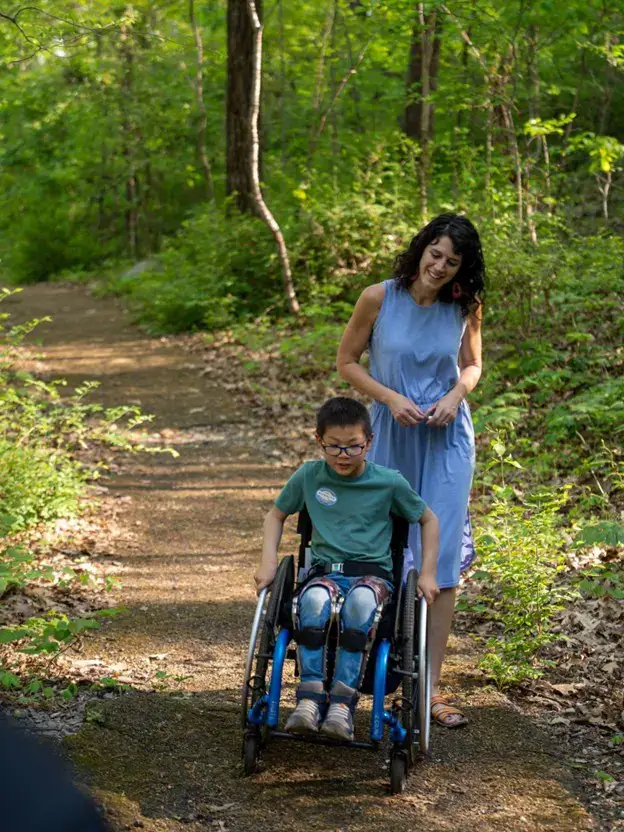
We take what looks like a trail, but too far in realize it wasn’t and now we can’t find our way back.
The map said there’s an elevator to the metro, but we can’t find it. There are no staff, only machines. We can’t find anyone who speaks English. The accessible entrance sign leads to a loading dock buried in trash bins… and this is the only transportation option to the airport for the flight home.
Sometimes we find ourselves completely lost, panicked, with no clear way out, while trying to keep three hungry kids from falling apart. We can’t think clearly because panic creeps in and the possibility of being stuck becomes painfully real.
Tips for navigating when we lose the road:
- Pause long enough for our nervous system to settle.
- If possible, ask for help. Some things just can’t be done on your own.
- Just move. If we curl up into a fetal position and give up, the kids will only get hungrier and we’ll only grow more panicked. Even if we’re moving in the wrong direction, we’re moving toward someone or something where we’ll be able to find help.
- Remember what matters. Our only job is to keep everyone safe until we find our way. In the long run, hours off track and even missed flights don’t matter. What does matter is how we carry our family through the moment.
In life
So many things change everyday. As a disability parent, we never feel prepared. There’s no book that seems to fit our child’s needs. We’re blazing our own paths.
The therapy everyone raved about doesn’t seem to be doing anything for our child. Or, even worse, these intensive physical therapy sessions are really making a difference, but the strain with missed school, missed work, and a family torn apart is no longer manageable.
The second opinion from that specialist we were finally able to see stands in such stark contrast to what our medical team has recommended all along that it’s impossible to see what’s best.
Every time we think we have a handle on medical routines and therapies, a new diagnosis or developmental need pops up and everything changes.
How can we be expected to move at all when we have no idea which way to go? It’s disorienting. It’s lonely. It’s just too much.
Tips for navigating when we lose the road:
- Stop and breathe. While taking a personal retreat may not be a realistic option, that doesn’t mean we can’t find a moment to breathe and think. Hiding in the closet is a viable option. Clarity cannot come through overwhelm.
- Find your people. This journey is isolating and while there may be no one sharing our exact journey, there are other people who understand the tumultuousness of our situation. Join a FB group built around your child’s diagnosis. Ask your doctor, social worker, or physical therapist for support groups or local resources.
- Take the next step. We don’t need a fully mapped route to get started. The longer we stay stuck, the more lost we feel.
- Name what’s true. “We’re lost, but we’re not stuck.” “We’re confused, but we’re capable.”
- Remember: every new trail was created by someone who didn’t know the way. Look at you – you’re a trailblazing rockstar!
When you stop to think about it, disability parents may be more prepared as travellers than anyone else. We’re already accustomed to flexibility, sleep deprivation, and heading off beyond the edges of the map. We live in a world of constant reroutes — adapting, adjusting, recalibrating. We know how to keep going when the plan changes, how to pivot when the road ends, and how to take brave steps even when the trail disappears beneath our feet.
This may not be the journey we expected, but we’ve become pretty good at finding our way. We’ve learned to find joy in alternate routes. That’s what keeps us moving: not certainty, not ease, but the stubborn belief that we will find something that works, another possibility, another reason to keep going.
We may not have a perfect map, but we’re raising families who know how to reroute with courage and that’s its own kind of destination
