
Listen to this Article
Q&A with Vivienne
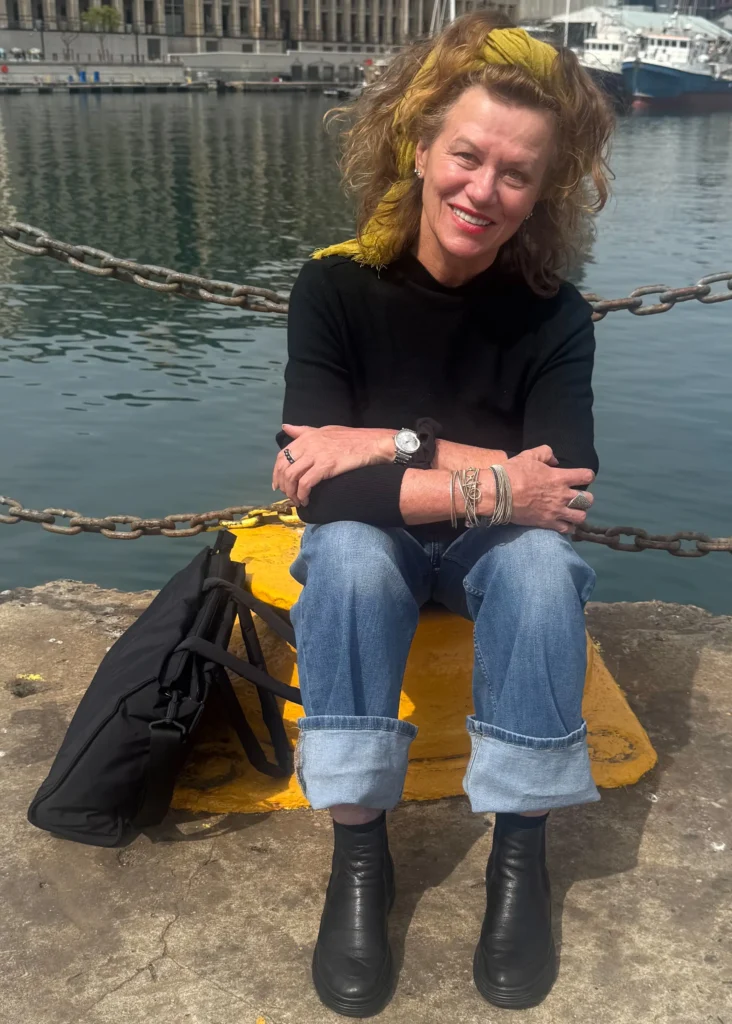
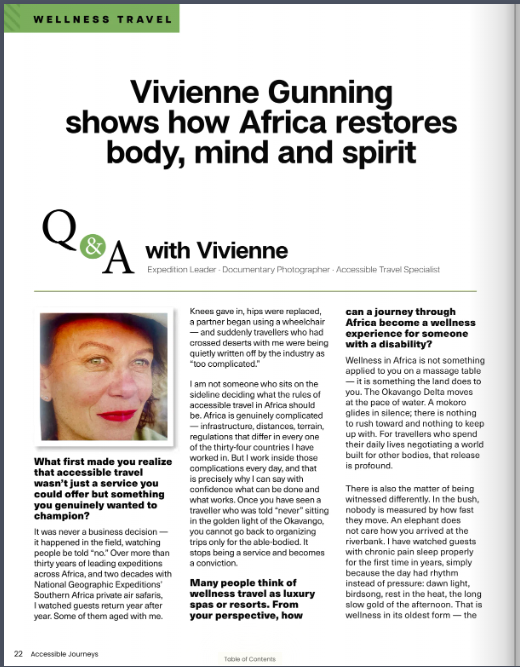
Vivienne Gunning | Senior Expedition Leader, photographer and accessible travel specialist, in the golden light of the African bush.
© Vivienne Gunning
What first made you realize that accessible travel wasn’t just a service you could offer but something you genuinely wanted to champion?
It was never a business decision — it happened in the field, watching people be told “no.” Over more than thirty years of leading expeditions across Africa, and two decades with National Geographic Expeditions’ Southern Africa private air safaris, I watched guests return year after year. Some of them aged with me. Knees gave in, hips were replaced, a partner began using a wheelchair — and suddenly travellers who had crossed deserts with me were being quietly written off by the industry as “too complicated.”
I am not someone who sits on the sideline deciding what the rules of accessible travel in Africa should be. Africa is genuinely complicated — infrastructure, distances, terrain, regulations that differ in every one of the thirty-four countries I have worked in. But I work inside those complications every day, and that is precisely why I can say with confidence what can be done and what works. Once you have seen a traveller who was told “never” sitting in the golden light of the Okavango, you cannot go back to organizing trips only for the able-bodied. It stops being a service and becomes a conviction.
Many people think of wellness travel as luxury spas or resorts. From your perspective, how can a journey through Africa become a wellness experience for someone with a disability?
Wellness in Africa is not something applied to you on a massage table — it is something the land does to you. The Okavango Delta moves at the pace of water. A mokoro glides in silence; there is nothing to rush toward and nothing to keep up with. For travellers who spend their daily lives negotiating a world built for other bodies, that release is profound.
There is also the matter of being witnessed differently. In the bush, nobody is measured by how fast they move. An elephant does not care how you arrived at the riverbank. I have watched guests with chronic pain sleep properly for the first time in years, simply because the day had rhythm instead of pressure: dawn light, birdsong, rest in the heat, the long slow gold of the afternoon. That is wellness in its oldest form — the body and the spirit returning to a natural pace. Africa offers it more honestly than any spa I know.
Many travellers with disabilities assume Africa is “too difficult.” What would you say to someone who has dreamed of going on safari but has convinced themselves it isn’t possible?
I would never insult them by pretending Africa is easy. It is not. There are long distances, uneven ground, small aircraft, lodges built on sand and stilts. Travellers with disabilities are experts on their own bodies, and they can smell a glossy brochure promise from a mile away.
What I say instead is this: difficult is not the same as impossible, and the difference between the two is planning done by someone who actually works in these places. I have spent three decades solving exactly these problems on the ground — which vehicles can take a transfer, which camps have level pathways, where the distances between room and dining area are honest, where the staff attitude turns a barrier into a non-event. When the groundwork is done properly, the safari itself is often far gentler than people imagine: you are seated in a vehicle or a boat for the best parts of the day, with the wilderness coming to you. The dream is not the unrealistic part. Travelling with the wrong operator is.
Travelling with a disability can sometimes feel exhausting before the trip even begins. How do you help your guests reduce that stress so they can focus on simply enjoying the experience?
By doing the exhausting part for them, and by telling the truth. The pre-trip fatigue comes from uncertainty — sending the same questions to five different suppliers and getting vague answers back. So I answer the unglamorous questions before they are asked: exactly how you will board the aircraft, how wide the bathroom door is, how far the tent is from the dining area and over what surface, where medication can be refrigerated, what happens if equipment fails in the bush.
I also build itineraries with margin. Nothing on my expeditions is scheduled back-to-back, because a buffer that an able-bodied traveller never notices is the difference between dignity and distress for someone managing energy or equipment. And there is one point of contact — me — from the first enquiry to the last transfer. When a traveller knows that someone who has personally stood in every location is holding the whole thread, the anxiety drains away, and what is left is anticipation. That is how a holiday should begin.
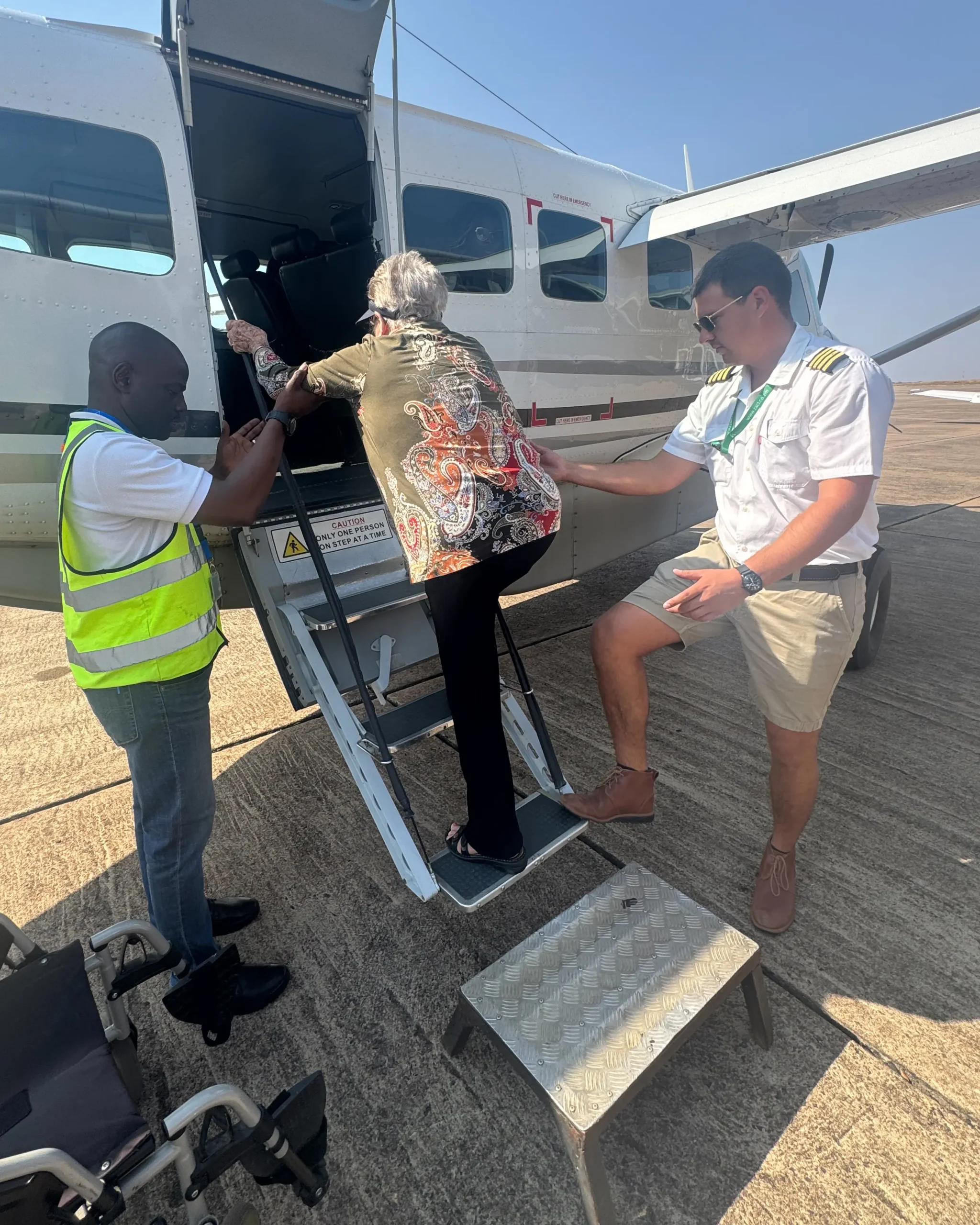
You’ve travelled with people who have mobility disabilities, older travellers and those with invisible disabilities. What are some of the biggest misconceptions you wish the travel industry understood about accessible travel?
The first misconception is that accessibility equals a ramp. A ramp is the beginning of a sentence, not the whole story. Access is the width of a doorway, the height of a bed, the firmness of a path after rain, the distance a person must cover between four in the morning and a game drive, and whether staff have been trained to offer help without taking over.
The second is that disabled travellers are a small niche. They are not — they are older travellers, travellers with arthritis, heart conditions, low vision, chronic fatigue, anxiety; they are the fastest-growing segment of travel, and they rarely travel alone. Turn one traveller away and you turn away the family travelling with them.
The third, and the one I fight hardest, is the assumption that the traveller is the problem to be managed. Travellers with disabilities are the most experienced problem-solvers I have ever guided. The industry’s job is not to manage them; it is to give them accurate information and get out of the way of their competence.
How do you balance adventure with safety when planning journeys into remote parts of Africa for travellers who may need additional support?
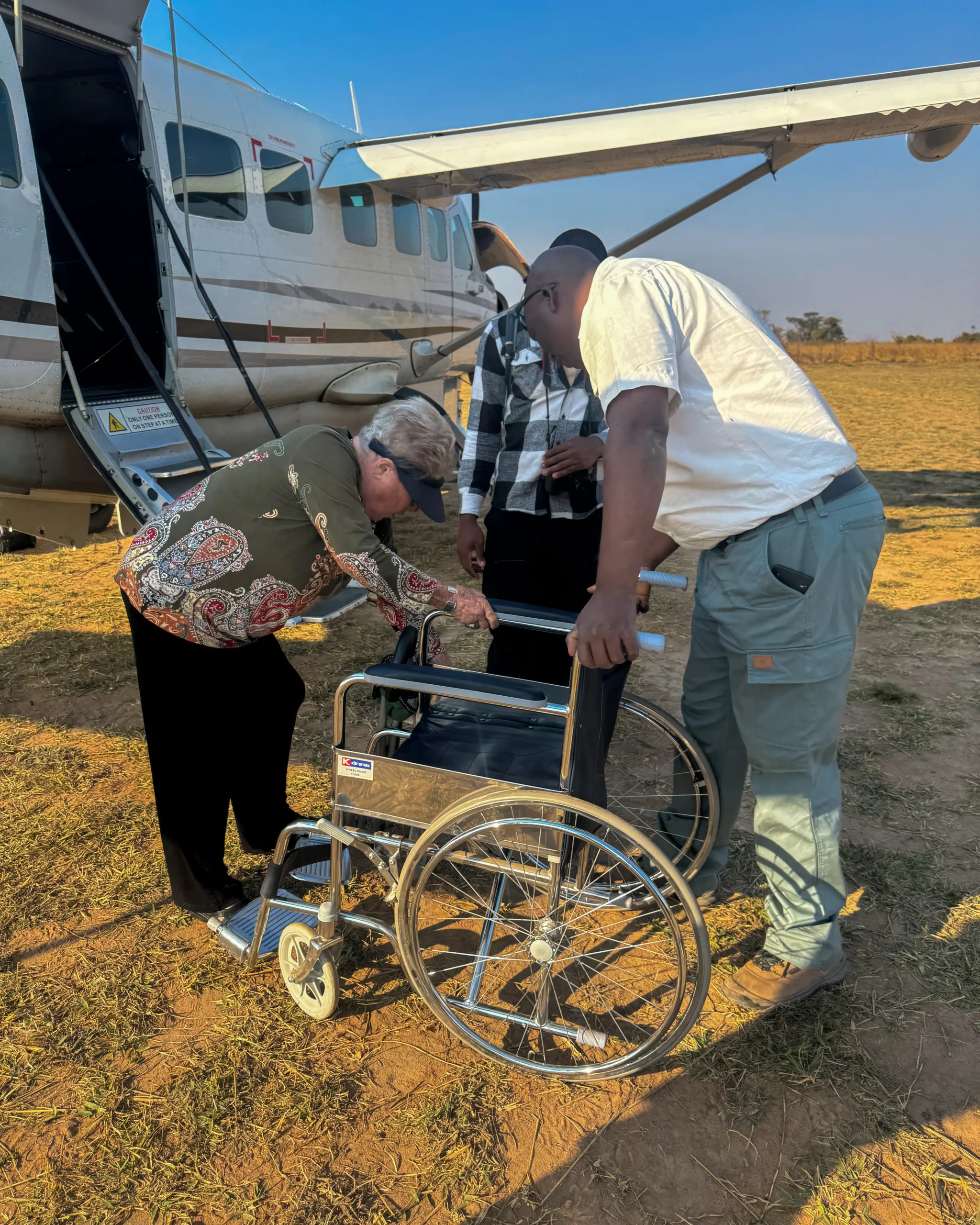
Safety in remote Africa is not a document; it is a web of relationships and redundancy. I work with camps and guides I know personally — people who will improvise intelligently when the plan meets reality, because in Africa the plan always meets reality. Before I take any traveller into the field, I know the medical evacuation arrangements, the nearest reliable clinic, how a wheelchair or oxygen concentrator travels on a light aircraft, and what the backup is if a vehicle, a charger or a border post fails.
But here is the part that matters: safety planning must never be allowed to shrink the adventure. The goal is not to wrap a traveller in cotton wool; it is to build such a strong quiet framework underneath the journey that the traveller never has to think about it. Adventure is the point. My guests did not come to Africa to be kept safe — they came to feel alive, and my job is to make sure both things are true at once.
You’ve spent decades immersed in Africa’s landscapes and wildlife. How have you seen nature improve travellers’ confidence, mental wellbeing or sense of peace during a trip?
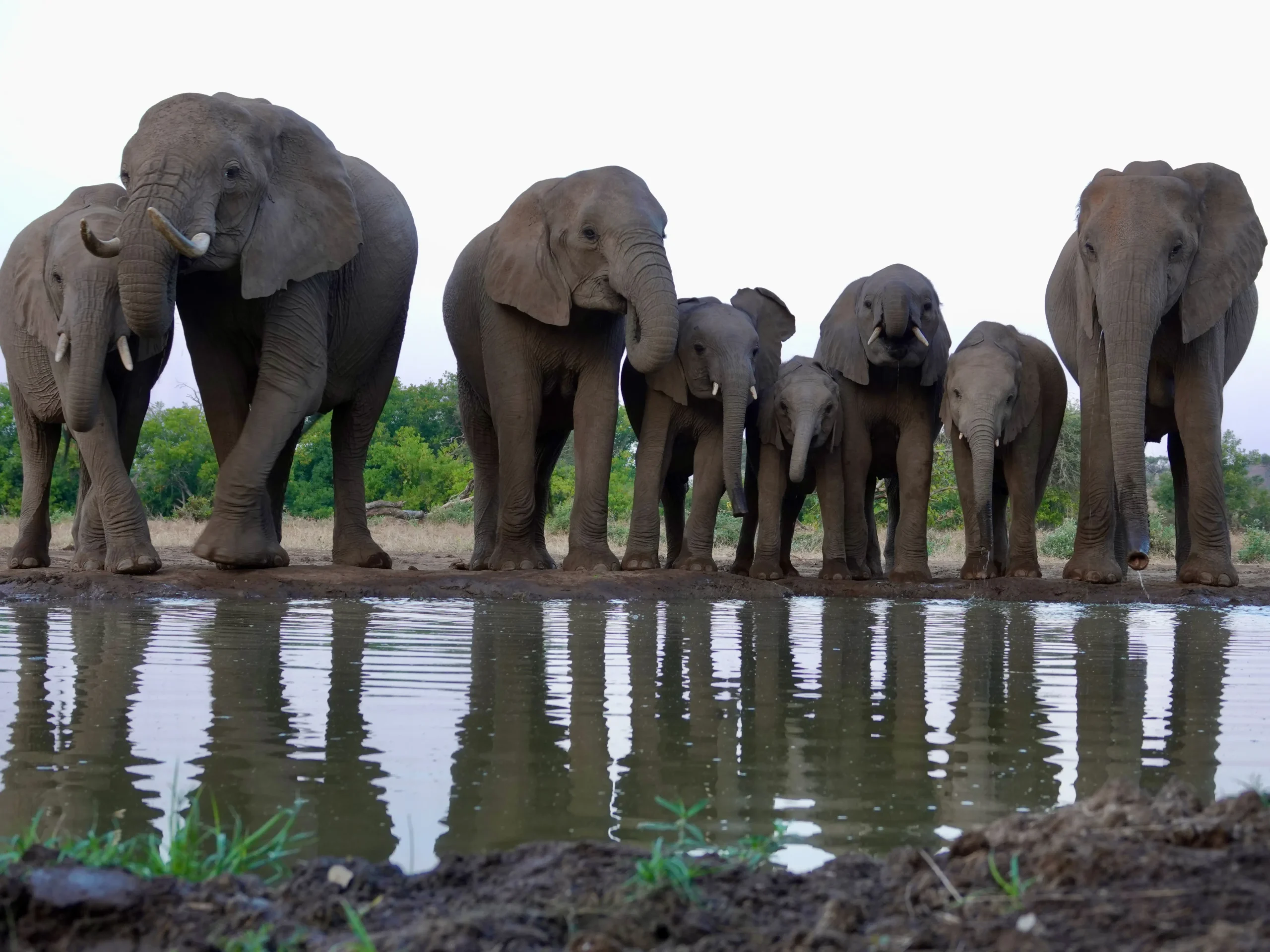
I have watched it happen so many times that I no longer think of it as remarkable — only as reliable. Guests arrive tight-shouldered, apologizing for themselves, braced for the trip to go wrong. Somewhere around the second or third day, the bush does its quiet work. The scale of the land recalibrates a person. Worries that felt enormous at home look different beside a herd of elephants that has been walking the same paths for generations.
For travellers with disabilities the shift is often even deeper, because the wilderness makes no comparisons. Nobody in the Delta is watching how you walk. I have seen guests who barely spoke on arrival telling stories around the fire by the end of the week, and travellers who had stopped trusting their own bodies discover that they could do more than they believed — not because anything was forced, but because the environment invited it. People stand taller when they leave Africa. I have watched it for thirty years, and it never stops moving me.
“Vivienne has been a Godsend to me. She has helped me accomplish things that I never could have done without her and her expert help. She worked a miracle when it came to me going to Egypt to see the pyramids.”
— Esther Murray, accessible traveller, USA
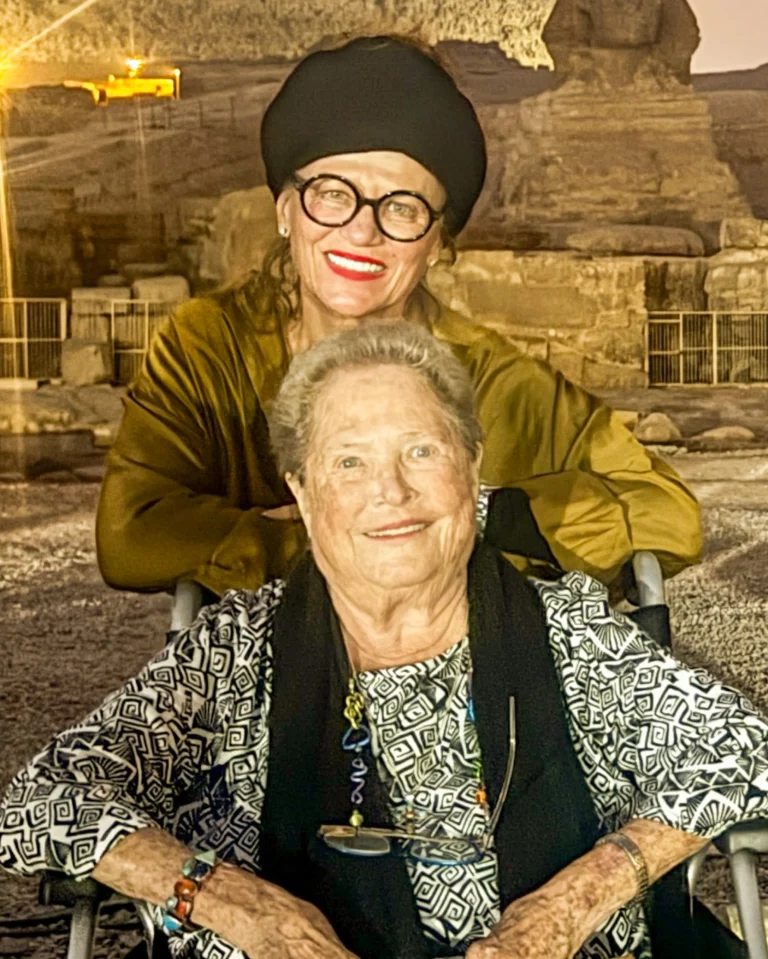
Vivienne Gunning with guest Esther Murray (USA) at the Great Sphinx, Giza, Egypt — the journey Esther described as “a miracle.” © Vivienne Gunning
Beyond the wildlife, are there particular cultural experiences, communities or places in Africa that you feel nourish the soul and leave travellers feeling renewed?
People come to Africa for the wildlife and go home talking about everything else — because this continent’s deepest renewal is cultural and human. Think of Morocco, where you can immerse yourself for weeks and barely scratch the surface: losing yourself in the souks of Marrakech and discovering the women’s museum tucked in among the stalls, where the stories of Moroccan women are honoured and told. Or Essaouira on the Atlantic coast, one of my favourite places to simply slow down — walking the quay in the morning, watching the fishermen bring in their catch among the blue boats and wheeling gulls. Nothing is staged there. It is life, and you are welcomed into it.
Then there is music and faith. Ghana hosts several high-end jazz nights, and there are few things more renewing than an African crowd and live music under a warm night sky — rhythm is this continent’s mother tongue. In Ethiopia, the rock-hewn churches of Lalibela leave travellers speechless: pilgrims in white moving through passages carved from living stone eight centuries ago, devotion you can feel in the air. And on Lake Tana, the island monasteries hold treasures and traditions reaching back to the very roots of Christianity. In every one of these places, the experience and the people are inseparable — you witness the culture through its keepers, and it is that human welcome, far more than any single sight, that travellers carry home feeling renewed.
You believe travel should happen at the traveller’s pace rather than the itinerary’s pace. How does slowing down often create richer travel experiences for everyone, not just disabled travellers?
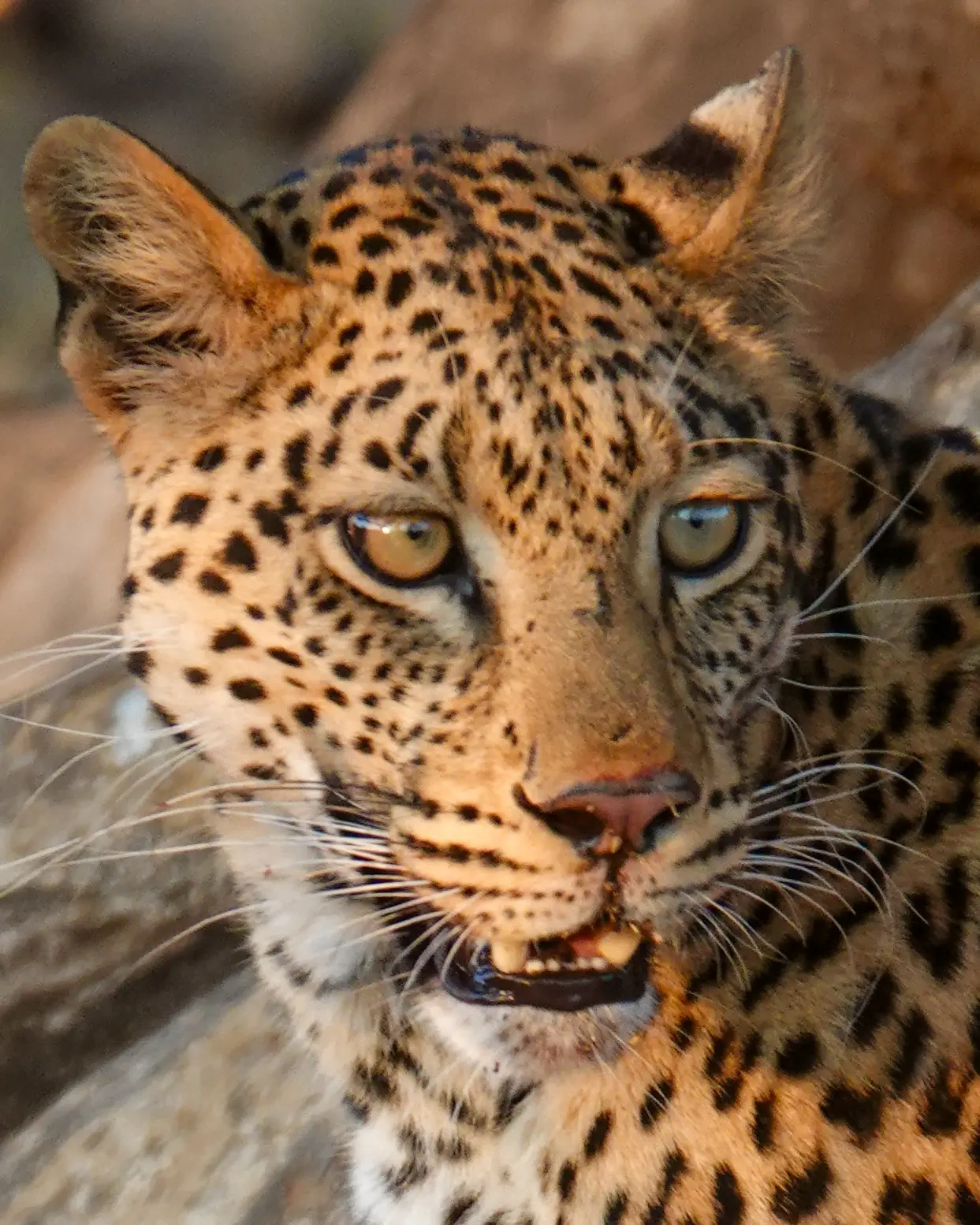
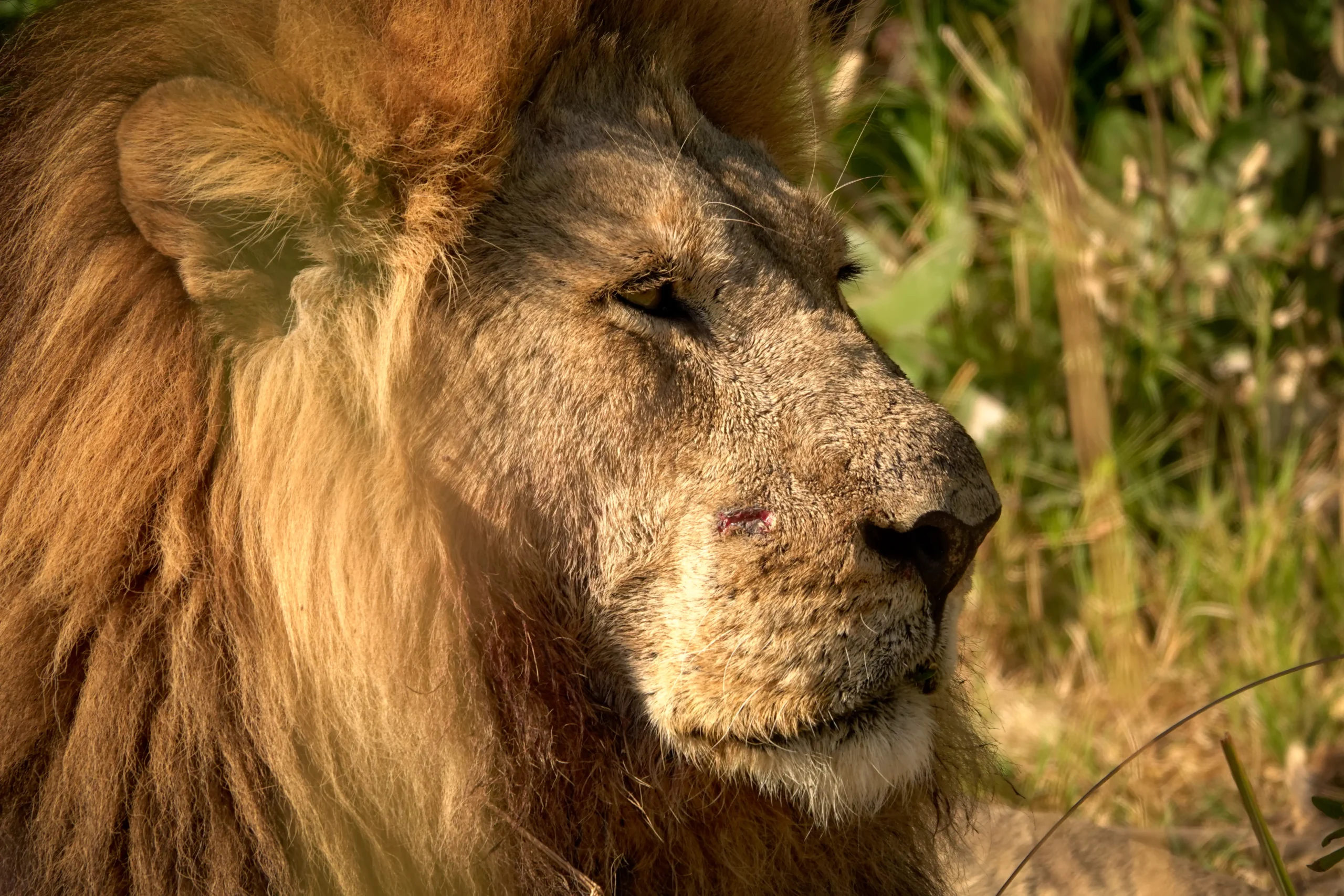
The itinerary is a servant, not a master — I have believed that my whole career. When you rush, you collect sightings; when you slow down, you collect meaning. Some of the most extraordinary moments I have witnessed in the bush happened because we stayed twenty minutes longer than the schedule wanted: the lioness finally crossing the clearing, the light turning the water to bronze, the story a guide only tells when nobody is looking at their watch.
Designing for travellers who need more time has made every expedition I lead better for everybody. Able-bodied guests constantly tell me the unhurried pace was the greatest luxury of the trip — more than the linen, more than the wine. We are all over-scheduled at home. Nobody flies to Africa to be over-scheduled there too. Slowness is not a compromise made for disabled travellers; it is the correct speed for the continent, and disabled travellers simply taught the rest of us to notice it.
For wheelchair users or travellers with limited mobility, which African destination has surprised you the most in terms of accessibility or welcoming attitudes?
South Africa surprises people the most, and it is where I usually recommend a first journey. Cape Town has genuinely usable infrastructure — accessible transport, adapted accommodation, boardwalks and viewpoints where a wheelchair user is a traveller like any other, with Table Mountain’s cableway and the waterfront well within reach. Pair that with a private game reserve where distances are short, vehicles can be adapted and staff ratios are generous, and you have a world-class safari without heroics.
But the deeper surprise is attitude, and there Botswana has moved me most. Formal infrastructure in the Delta is limited — it is sand, water and wilderness — yet I have watched camp staff and polers solve problems with such natural grace and ingenuity that guests forgot they had ever worried. A lack of ramps can be overcome by people who genuinely want you there. A perfect ramp cannot overcome people who don’t. Africa’s greatest accessibility asset has always been its people.
Accessible travel often comes with unexpected challenges. Can you tell us about a moment when a trip didn’t go according to plan and how you adapted without losing the joy of the experience?
In Africa the question is never whether the plan will bend — only when, and how gracefully. I will never forget a private air expedition through Kenya, when one of my guests joined the Maasai warriors in their famous jumping dance. He jumped like a Maasai — and landed like a man who had just broken his femur. We were deep in the Mara, with no hospital anywhere close. Fortunately we travelled with a camp doctor, who stabilized the leg that night, and the next day we flew him by light aircraft to Nairobi, where the leg was further stabilized.
Now, most people would assume the story ends there, with a sad flight home. But this was a private air journey, and flexibility was built into its bones. He decided he was not finished with Africa. We flew on to Ethiopia, where an excellent orthopaedic surgeon stabilized the leg completely — the operation, he decided, would wait until he got home. So he completed the expedition: Ethiopia, then Egypt, and only then home for surgery. What moved me most was the group. Every single guest agreed to the adjusted plan without hesitation, and everybody rallied around him — carrying, encouraging, celebrating every stage he managed.
And it worked out. He saw Lalibela and the pyramids with a broken femur and a grin, and that dance became the legend of the trip rather than its ending. That is the lesson I carry into every accessible journey I plan: with the right preparation underneath — medical support, evacuation options, flexible transport — a crisis becomes a detour, not a defeat. The joy does not have to be the casualty. Sometimes it is the thing that grows.
Your photography captures quiet moments as much as iconic wildlife. How do you encourage travellers to notice the smaller experiences that often become the most meaningful memories?
I tell my guests: the lion will be photographed a thousand times today; the way the morning light fell across your own hands on the mokoro will happen once. My photography has always been about witnessing rather than trophy-hunting with a lens — I shoot everything on one small Sony RX10 IV, no fuss, no intimidating equipment, because the camera should never be bigger than the moment.
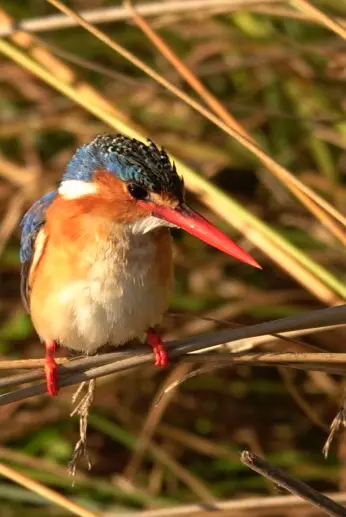
In practice, I slow the group down and direct their attention to the small theatre happening everywhere: a dung beetle’s absurd determination, the pattern reeds make against water, the sound of a fish eagle before you find it in the sky. I encourage guests to put the camera down entirely at least once a day and simply be present, because a memory made with the whole body outlasts any photograph. And without fail, when guests write to me months later, it is the small moments they mention — the chai, the frog chorus, the poler’s laugh. The icons impress. The quiet moments belong to you.
What practical questions should disabled travellers ask a tour operator before booking a trip to Africa that many people don’t think to ask?
Ask questions that force specifics, because vagueness is where trips fail. Not “is the lodge accessible?” but: Have you personally been there — and when? How wide, in centimetres, is the bathroom door, and is there transfer space beside the toilet and bed? What is the surface and distance between my room and the dining area, and what happens to it after rain?
Then the ones almost nobody asks: How will I board the safari vehicle and the light aircraft, exactly — is there a step, a lift, a trained team? What is the luggage weight limit on the small planes, and does my mobility equipment count against it? Where can medication be kept cold, and is there reliable power at night for a CPAP or a chair charger? What is the medical evacuation arrangement, and does my insurance actually cover the countries and activities on this itinerary? And finally: Can the daily programme flex if I need a slower morning — and who decides?
An operator who welcomes those questions is an operator you can trust. An operator who bristles at them has just told you everything you need to know.
Many people focus on physical accessibility, but you also write about confidence, dignity and emotional wellbeing. Why are these just as important when creating an accessible journey?
Because a ramp gets a person into the room, but dignity is what determines whether they are glad to be there. I have seen technically accessible trips that were emotionally miserable — travellers handled like freight, discussed in the third person while sitting right there, “helped” without being asked. And I have seen journeys through rough, imperfect terrain that left guests glowing, because every interaction said: you belong here, you are the traveller, this is your expedition.
The emotional architecture of a journey is built from small decisions. Speaking to the traveller, never over them. Offering assistance as a question, not a seizure. Building enough margin into the day that nobody is ever the reason the group is waiting. Protecting privacy around personal care. These things cost nothing and change everything. Many of my guests have spent years being made to feel like an inconvenience, and the deepest gift a journey can give them is not the wildlife — it is a week of being treated, simply and consistently, as the explorer they are. That is what they take home. That is what changes lives.
If someone were visiting Africa for the very first time and wanted a trip that combined wildlife, culture and accessibility, what itinerary would you recommend and why?
For a first journey I recommend Southern Africa, built around South Africa’s infrastructure with wilderness added at the right dose. Begin in Cape Town: it is one of the most accessible cities on the continent, and it lets a traveller find their feet — Table Mountain, the coastline, the winelands, markets and music, all with adapted transport and accommodation that actually works. Culture and comfort first, so confidence is high before the bush.
Then fly to a private game reserve in the greater Kruger region, where the crucial ingredients for accessible safari come together: short distances, exclusive vehicles that can adapt to the traveller rather than the other way around, generous staff, and superb wildlife without long punishing drives. For those ready for one more step, finish at Victoria Falls, where good pathways bring one of Earth’s great spectacles within reach, or add the Okavango Delta by light aircraft for the water wilderness. The shape of the trip matters more than the destinations: city, then bush, then wonder — each stage building the traveller’s trust in Africa, and in themselves. Ten to twelve days, never rushed.
Looking ahead, what changes would you most like to see across Africa’s tourism industry to make the continent even more welcoming for travellers with disabilities?
Three things. First: accessibility at the design stage, not as a retrofit. When a camp is being built on the sand, a level pathway and a wider doorway cost almost nothing; ten years later they cost a fortune. Every new lodge, vehicle and airstrip in Africa should be designed with disabled travellers assumed, not accommodated.
Second: honest, published, measured information. The industry’s greatest barrier is not sand or stairs — it is vagueness. I want to see real measurements, real photographs and real limitations published openly, so travellers can make their own expert judgements about their own bodies. “Partially accessible” is not information; it is an evasion.
Third — and closest to my heart: nothing about disabled travellers without disabled travellers. Audits, training and product design must involve the people who actually live the experience, and the industry must stop treating accessibility as a compliance cost and recognize it as what it is: the largest under-served market in world tourism, attached to families, attached to loyalty, and attached to some of the most determined travellers on Earth. Africa taught the world to travel. It can lead here too.
If you could leave our readers with one message about accessible travel and one reason they should never give up on seeing the world, what would it be?
My message is this: your dream does not have a disability. It may need better planning, more honest information and a guide who works in the real Africa rather than the brochure Africa — but the horizon has not moved. It is still there, waiting, exactly where you left it.
And the reason never to give up is simple: the world is not finished with you. I have led travellers in their eighties, travellers on wheels, travellers carrying grief and illness and fear, and I have watched every one of them find something out there that no obstacle had managed to take away — awe. Awe does not check your mobility. The elephant at the waterhole, the Delta turning to gold, the stranger who becomes a friend over a cup of chai: these are not reserved for the able-bodied. They are reserved for the ones who come. I have lived my life by one line, and I offer it to your readers as an invitation: my feet on the earth, my eyes on the horizon. Keep yours there too.
Closing remarks
Only gratitude — to Accessible Journeys for taking African accessible travel seriously, and to every traveller who has trusted me with their dream over these thirty years. I would add one practical note for readers: accessible travel in Africa is advancing quickly, and much of the best information never reaches the big booking platforms. Talk to specialists who work on the ground, ask the hard questions, and start the conversation earlier than you think you need to — the best journeys are built slowly, like everything worthwhile in Africa. My door is always open to any traveller who has been told “no” and suspects the answer might really be “not yet — let’s find out how.”
My feet on the earth. My eyes on the horizon.
Vivienne Gunning
ABOUT VIVIENNE GUNNING
Vivienne Gunning is a Senior Expedition Leader, documentary photographer, painter and travel writer based in Gordon's Bay, near Cape Town, South Africa, with more than thirty years of hands-on field experience across thirty-four African countries. She has led and co-led over one hundred high-end expeditions for National Geographic Expeditions, WWF and Bushtracks Expeditions, including two decades for National Geographic Expeditions' Southern Africa private air safaris — flagship journeys such as Casablanca to the Cape, Cape to Cairo, Sahara by Air.
Her connection to the continent began in childhood, on her grandparents' farm on the Limpopo River bordering Botswana, where her grandmother read National Geographic aloud to her — a seed that grew into a lifetime of leading travellers to the places on those pages. Today she is an Accessible & Assisted Travel Specialist, an Advisory Board member and contributing author for Accessible Travel Press, and the creator of women-only expeditions including Women Walking the Delta in Botswana's Okavango. She is not an armchair commentator on accessible travel in Africa: she is an active expedition leader who works inside the continent's real complexities every day, and advises on what can genuinely be done and what works.
Her approach rests on human judgement rather than checklists: gentle pacing, reading subtle cues, proactive reassurance, and decades of local relationships that turn ambitious adventures into safe, dignified and deeply rewarding journeys — without diluting the wild. Vivienne holds a Fine Art degree from the University of Pretoria and a Professional Digital Photography certification from the University of Cape Town, and is completing her FGASA field guide training. Her photography and long-form travel writing — spanning wildlife, documentary and the quiet human moments in between — appear on her website and Substack.
She lives by one line: “My feet on the earth. My eyes on the horizon.”
WHAT VIVIENNE OFFERS
Accessible and assisted travel planning for Africa. Bespoke journeys designed for solo travellers, seniors, travellers with mobility, stamina, health or confidence challenges, and those with invisible disabilities — built on personally verified, honest information about vehicles, aircraft, camps, distances and terrain, with realistic pacing, dignity and flexibility designed in from the start.
Structured consultation. A clear three-step process: an initial consultation to understand goals and give a realistic overview of what is possible on the ground in Africa; a concept and groundwork phase outlining suitable destinations, travel style and accessibility considerations per region; and detailed itinerary development and implementation, with on-the-ground support where appropriate.
Personally guided expeditions. Vivienne leads her journeys herself, providing a single expert point of contact from first enquiry to final transfer, drawing on three decades of on-the-ground relationships with camps, guides, pilots and medical support across Southern and East Africa.
Women Walking the Delta. A women-only walking and mokoro expedition into Botswana’s Okavango Delta, created for solo women travellers with no single supplement — slow, safe, deeply immersive wilderness travel at the traveller’s pace.
First-hand accessibility reviews. As a contributing author for Accessible Travel Press, Vivienne conducts independent, first-person accessibility assessments of properties and experiences — arrival, accommodation, bathrooms, dining, activity areas and staff awareness — published as honest editorial that travellers with disabilities can trust before they book.
Talks, workshops and storytelling. Motivational talks and workshops for groups and corporate events on resilience, women’s strength and trading comfort for curiosity, alongside documentary photography and long-form travel writing available for publications and collaborations.
Contact and Links
Website: viviennegunning.com
Accessible travel: accessibletravel.online
Writing: viviennegunning.substack.com
Instagram: @viviegunning | @accessibletravelonline
Facebook: facebook.com/AccessibleTravelOnline
LinkedIn: linkedin.com/in/viviennegunning
Email: gunningvivienne@gmail.com
Mobile: +27 82 795 0411
Read Vivienne’s recently published article for Accessible Travel Press:
Africa’s Hidden Places Belong to Them Too
The article explores accessible travel in remote parts of Africa, including realistic risk assessment, emergency planning, honest pre-trip communication and the importance of finding responsible ways to support travellers without automatically limiting their aspirations.